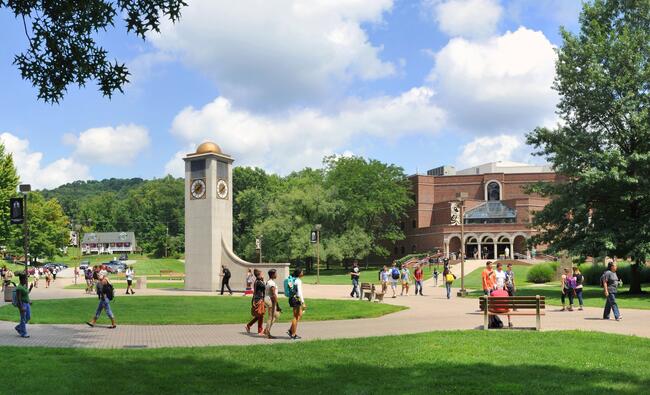
West Virginia State University is among the historically Black land-grant universities now receiving more equitable state funding.
West Virginia State University
Three years ago, the Biden administration publicly scolded 16 states for underfunding historically Black land-grant universities by a whopping $13 billion over 30 years. The then–education and agriculture secretaries asked the states to pay up.
The Biden officials, in letters to the 16 governors, called states out for low per-student spending on their historically Black land-grants compared to their predominantly white counterparts. States are supposed to equitably distribute funds between the institutions and annually match federal land-grants for food and agriculture research. But states haven’t always doled out all of those matching funds to historically Black universities, which can prevent institutions from accessing their total federal money. And in some cases, states lavished more generous allocations on predominantly white land-grant institutions, leaving historically Black land-grant universities at a disadvantage for decades.
Several years later, did the Biden administration’s pressure campaign work?
Historically Black land-grant leaders and advocates say not entirely—but many states did make strides, paying institutions their full land-grant matches after years of neglect and chipping away at their debts.
The letters have “clearly been a catalyst for more states to follow the law and meet the matching requirements,” said Felecia M. Nave, president and CEO of the 1890 Universities Foundation, which advocates for historically Black land-grant institutions.
And some of that momentum has continued into the new administration. Nave pointed out that President Donald Trump’s executive order on HBCUs also encouraged states to pay their matches “to keep the pressure on.” Although states haven’t necessarily paid off their cumulative debts, all historically Black land-grant institutions—except Prairie View A&M University—appear to have received their matching funds for fiscal year 2025, according to data from the U.S. Department of Agriculture. But that’s because of a federal waiver that certain research funds don’t require a match for Prairie View. Nave’s organization is checking with institutions for any “discrepancies” in the data.
“We’re not 100 percent where we want to be,” Nave said, “but we’re very excited about what we’ve been able to achieve over these three years.”
Historically Black land-grant universities were established in 1890 after Congress gave states a choice: integrate existing land-grant institutions, established in 1862, or create new ones for Black students. Many Southern states opted for separate institutions.
When the Biden administration crunched the numbers, only two states—Delaware and Ohio—had equitably funded their historically Black land-grant universities, sometimes called 1890s institutions. Out of 19 institutions across the country, 16 were underfunded relative to peer institutions.
Ericke S. Cage, president of West Virginia State University and chair of the Council of 1890 University Presidents, said states haven’t made up for the billions of dollars that the Biden administration said was owed to these universities. But state lawmakers have made commitments to more equitable funding going forward, which he counts as a win.
“The bottom line is: Have we gotten to the significant numbers that the Biden administration brought to light? No, we haven’t,” he said. “But I think across the spectrum we have seen a lot of our states … stepping up and starting to make more investments in our 1890 land-grant institutions.”
Hard-Won Wins
Some 1890s institutions successfully secured their full state matches in recent years and made other gains in state funding.
West Virginia State University is one of them. In 2023, West Virginia lawmakers reaffirmed their commitment to “maximize the full federal matching requirement” for the state’s land-grant institutions.
The State Legislature also approved a $50 million appropriation to WVSU to build a new agriculture laboratory, “certainly a nod toward the fact that the institution has seen some significant underinvestment over the years,” Cage said.
Although these funds fall short of the upward of $800 million owed to WVSU, Cage’s goal is more modest—to “build a coalition of the willing amongst our Legislature … to help get new investments in the university where we can,” and that strategy has been successful.
“At West Virginia State, would I love for the university to receive a check for $852 million? Absolutely. That would be a game changer for our institution,” Cage said. “It would give us more capacity, more ability to deliver on our mission for students and for the state of West Virginia. But I think that’s probably unrealistic in this current environment.” (The governor’s proposed budget for fiscal year 2027 includes about $12 million for West Virginia State, plus about $5 million for its land-grant match.)
Leaders at Langston University in Oklahoma told Inside Higher Ed in a statement that they’ve “worked closely” with state lawmakers over the past few years to bring state funding into alignment with federal land-grant funding—and it’s paid off. The state not only met the one-to-one match for fiscal year 2027 but also exceeded it, the statement noted. The funding boost made it possible for the university’s Office of Cooperative Extension and Outreach Programs to extend community engagement work to 55 Oklahoma counties, “with plans for continued expansion.”
The University of Maryland Eastern Shore has also since received its match from the state, Robert J. Vickers, the university’s vice president for strategic communications and marketing, wrote in an email to Inside Higher Ed.
“We are fortunate in Maryland to have a governor who recognized the funding imbalance and has answered the statutory call that requires a 1:1 state match tied to federal funding supporting agricultural research, extension and forestry,” Vickers said. He thanked Gov. Wes Moore, the state’s first Black governor, for moving “to redress the historic neglect of Maryland’s only land grant HBCU.”
Texas state lawmakers slated $7.5 million per year in state match funding for Prairie View A&M for the biennium in 2023 after decades of advocacy by university officials, the university’s president, Tomikia P. LeGrande, wrote in an email to Inside Higher Ed. The matching funds, which came before the Biden letters, helped the university expand its cooperative extension services, community engagement work that’s part of the land-grant mission, from 50 counties to 75, with a goal of reaching 100 counties by the end of 2026. The money is also supporting an initiative to promote health and address health disparities in the greater Houston area.
Lincoln University in Missouri received its full land-grant funding from the state starting in 2022, also before the Biden administration called attention to the issue, according to a statement from the university. But the institution has continued to celebrate the policy shift years later. Lincoln put out a news release in January 2025 announcing it got its full match for the 2024–25 fiscal year and noting that wasn’t always the case. Lincoln reported receiving only half of its state match in 2021, $4.9 million instead of $9.75 million.
“Achieving a full state match each year is critical to our success in achieving our mission,” Lincoln University President John Moseley said in the release. “Allowing us to fully leverage federal support, these resources strengthen opportunities for Lincoln students and faculty and positively impact the state, the Midwest region and beyond.”
Tennessee state Rep. Harold Love Jr. fought a lengthy battle that spanned generations for the money Tennessee State University is owed.
Love’s father, also a state lawmaker, wrote a report about the university’s underfunding in 1970. When Love Jr. picked up the issue in 2013, the state had underpaid TSU by about a million dollars relative to its federal land-grant funding that year while giving the University of Tennessee more than its one-to-one match. Funding for the two land-grant institutions was also divvied up based on the ratio of white to Black college-eligible people in the state—but those percentages haven’t been updated, Love said.
Love estimated in 2021 that the state owed TSU anywhere from $150 million and $544 million, a debt that accumulated between the fiscal years of 1957 and 2007. While the state has been paying its match since 2016, the underfunding added up. In the aftermath of the report, in 2023, the state forked over about $250 million to TSU, though some university supporters have advocated for more. Love said after the university spends the money allocated—and state lawmakers see the results—he believes the institution can ask for more.
In some ways, the Biden administration letters complicated Love’s efforts, he said. The administration estimated Tennessee underfunded TSU by $2 billion, using federal data on per-student appropriations spending, a more expansive amount than the missing land-grant funding Love has been seeking.
“There was confusion,” he said. “Folks are calling me saying, ‘Hold on, I thought you said it was $544 million.’ I had to say, ‘It’s two different buckets.’ This huge number becomes even more of an emotional charge.” But he does credit the letters with “elevating the conversation about the underfunding, because the amounts were so large, it caused people to say, ‘OK, what’s going on here?’”
Despite these wins, the fight for equitable funding for historically Black land-grant institutions isn’t over.
A group of Florida A&M University students sued the state in 2022 over underfunding relative to predominantly white universities, and the case was heard this summer by the U.S. Court of Appeals for the 11th Circuit. The appeals court concluded the lower court moved too quickly in dismissing the case. (FAMU declined to comment on the university’s funding through a spokesperson.)
Love sees lawsuits as a last resort but believes 1890s institutions can make headway through advocacy to state lawmakers like he did on behalf of Tennessee State.
“You first have to get the data,” he said. “Someone breaks in my house, steals my TV off the wall—if I don’t show [police] the wall where the TV was taken off of and have a receipt from where I purchased it and even have pictures of where it used to be on the wall,” it’s much harder for them to help when “[I say], ‘I’ve been robbed. Do something about it.’”