
wombatzaa/iStock/Getty Images Plus
AI might appear to have killed the take-home essay and reincarnated it as in-class writing. This change comes at a steep cost, especially for the more advanced writing taught in college. Less revision and less in-class time for discussion hollows out humanities courses. Yes, there are still oral exams: The take-home essay may survive alongside well-designed discussions with each student. This kind of pivot from AI detection to learning verification is promising, but it may only work for lighter teaching loads. Meanwhile, many commentators assume that “policing” or “surveilling” artificial intelligence use on take-home essays is a dead end—and that AI detection and learning verification are mutually exclusive.
That assumption is a mistake. AI detection and prevention need not be “policing” or mere “surveilling.” With the right approach, fortifying the take-home essay against AI can present a genuine teaching opportunity that’s scalable across different teaching loads. Over the past two years, in both small seminars and a 70-student lecture, I’ve continued to assign take-home essays with the confidence that they let me evaluate students’ thinking. How? I make the writing process visible.
To do this, I use Process Feedback, a writing process visualizer. Developed by Badri Adhikari, a computer science professor at the University of Missouri at St. Louis, Process Feedback is a free browser extension that analyzes drafting and revision patterns in Google Docs. With it, I can efficiently read the rhythm of students’ writing: the recursive emergence and transformation of words on the page, the rhythm of their thought.
Process Feedback lets me establish AI-use policies that are enforceable and pedagogically sound because they lead students toward valuing the writing process and discovering their agency within it. In the coming years, we should expect to see more process-visualizer tools playing a central role in writing pedagogy. But Process Feedback is the best available right now, unmatched in my view by similar tools like Draftback or Turnitin Clarity.
Crucially, Process Feedback also corrects against many of the pitfalls of AI-based AI detectors, like Pangram. A 2025 study that found Pangram to be the best AI detector of those tested also named its limits, describing detection as a continuous “arms race” between detectors, LLMs and users adapting their AI use. That arms race is not a context conducive to student learning. Pedagogical interventions shouldn’t unfold on the dystopic terms of Silicon Valley: My AI versus your AI. As mirror images of the AI products they hunt, Pangram and other AI-based detectors heighten our risky dependence on black-box algorithms. Since a Pangram report tells us little about how students are writing, I only use it for baseline AI detection. It isn’t a good teaching tool.
In what follows, I describe how I use Process Feedback in essay grading, conversations with students and a classroom activity. How much time does it take to use Process Feedback? It depends. It takes me one to two minutes for every (apparently) AI-free essay to skim a Process Feedback report for pedagogical talking points. For each essay flagged as significantly AI-generated by Pangram, I take five to 15 minutes to analyze a Process Feedback report and possibly prepare notes for an email to the student arranging a meeting. There’s a learning curve here. Distinguishing red flags from student idiosyncrasies and adapting rhythm analysis to different assignments takes some time—but less once you get the hang of it.
Here’s how it works: Each of my students writes their take-home essays in their own Google Doc, with each essay in its own tab. The examples below are from essays by one of my students, shared with their permission. Process Feedback’s browser extension adds a toolbar at the top of Google Docs.

Chris Gortmaker
Here, I can see that throughout a whole course, this student made 30,912 edits. Clicking the “Writing Process Report” button opens a report that includes a writing process summary, a writing replay function, a counter of active writing time and a series of different tables or graphs that present data on the writing process. I only use a few of these. The first one I look at is the table of copy-paste activity, which distinguishes between internal and external copy-paste events. This means that I can enforce course policy that students are not allowed to paste any external text into their document without my permission. Students who try to use AI-generated text must copy it over into their document by typing each word—and this changes the rhythm of their writing.
I then look at a table that breaks down their daily editing activity. From this, I can see whether a student wrote the essay over several days or the night before.
Next, I turn to Process Feedback’s two most useful graphs: One visualizes the ratio of text added to text removed, and the other visualizes where and when edits occur in the document. These graphs immediately illuminate the rhythm of a student’s writing.
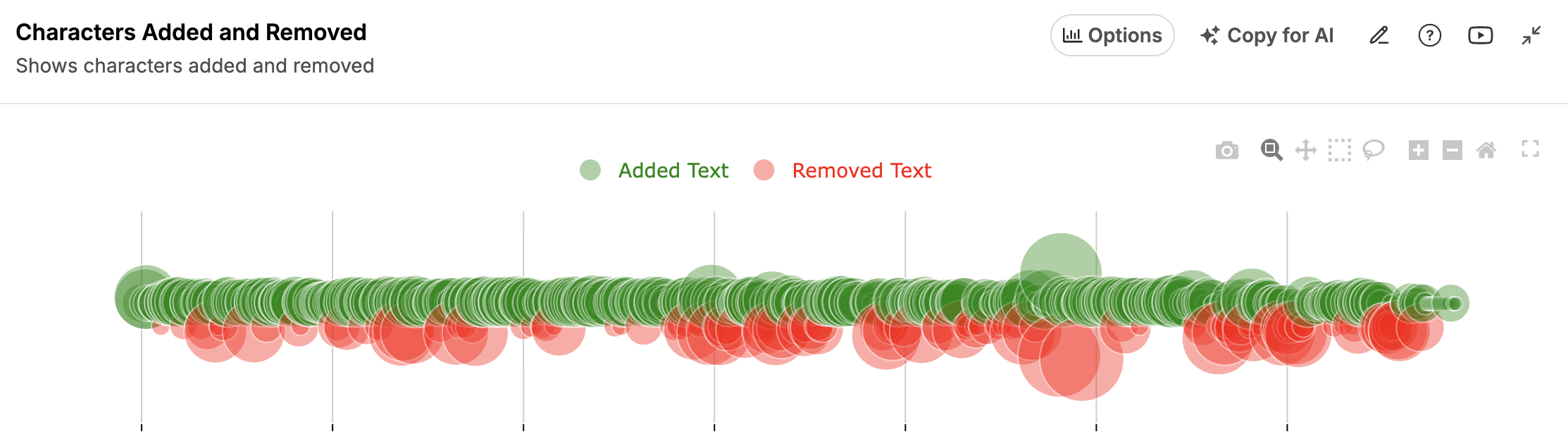
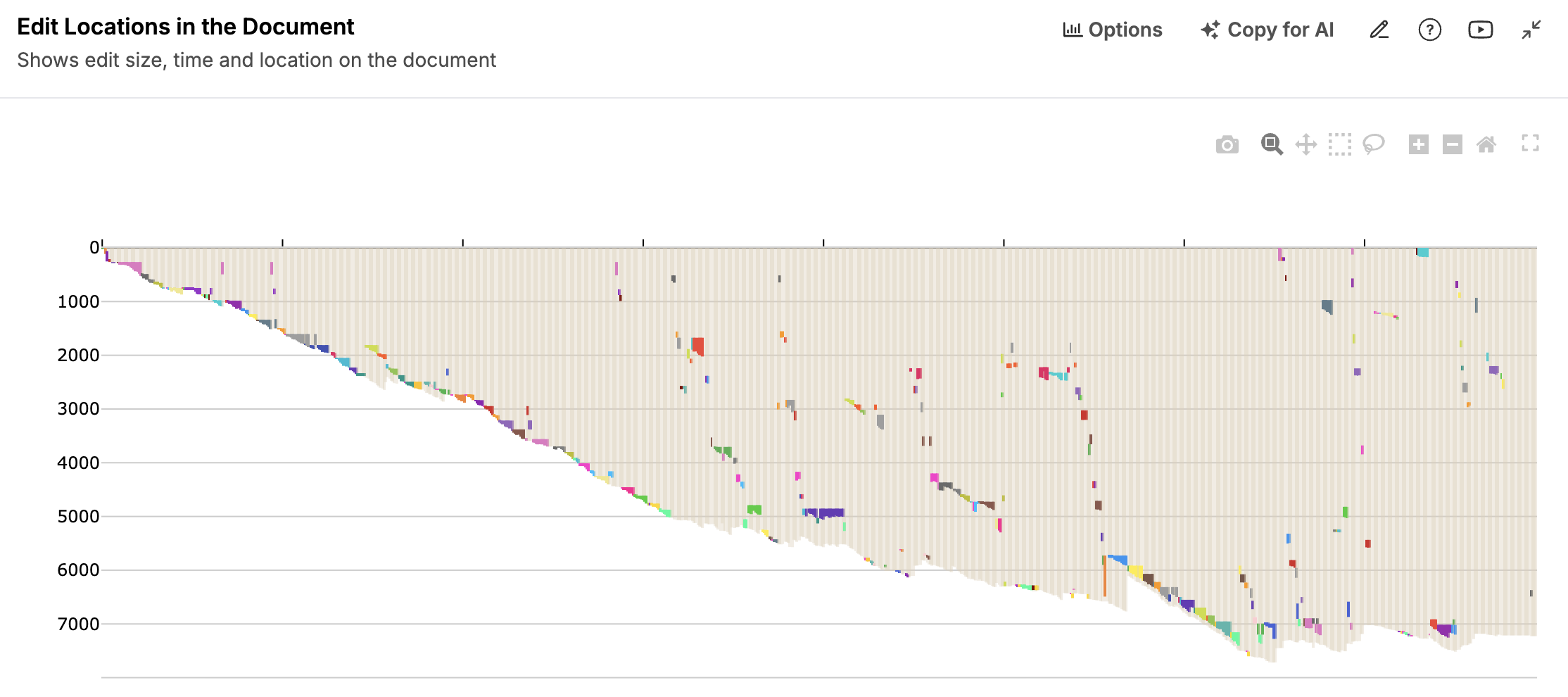
It’s helpful to first get a sense of what these graphs look like for an essay with no AI assistance and a writing process that’s distinguished by regular and extensive revision:
Chris Gortmaker
Chris Gortmaker
The first graph visualizes the ratio of text additions to deletions—green to red. They’re balanced. And the second graph visualizes where these edits occurred within the student’s Google Doc. The X-axis is time, and the Y-axis is number of characters in the document. Each little block of color represents an edit to a sentence at that point in the document.
We see cascading waves of edits. This is what the writing process should look like: thoroughly revised writing as a means of thinking deeply.
We can see this writing process flatlining if we look at how these graphs appear for an essay written with AI—in this case, an essay that Pangram flagged for me as mostly AI-generated (with high confidence):
Chris Gortmaker
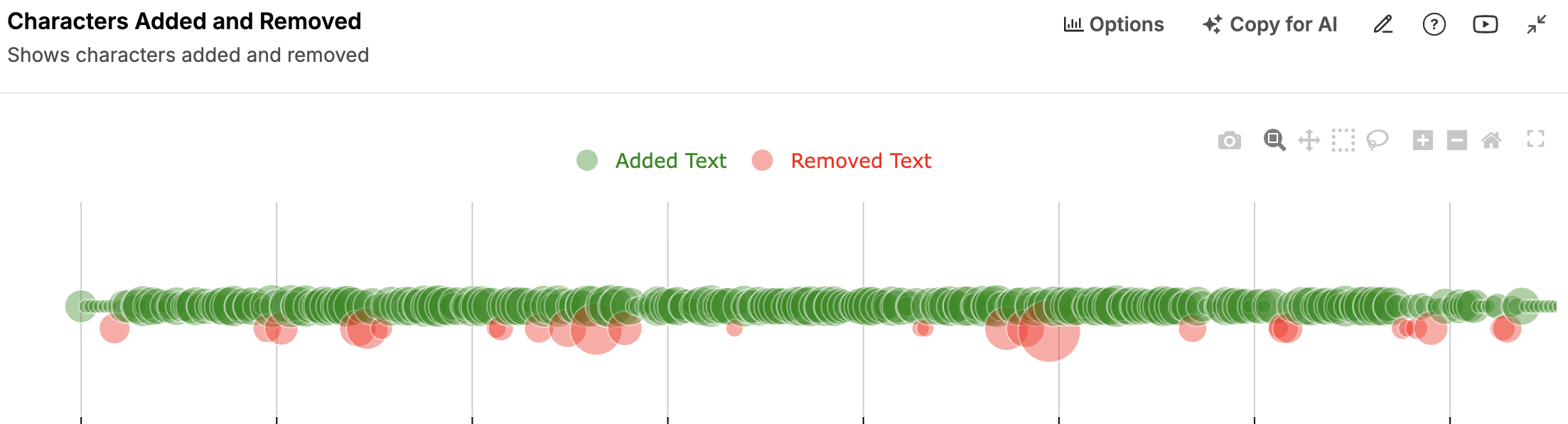
Here, the predominance of added text over removed text—green over red—is a common attribute of AI-assisted writing processes. The student who wrote this essay admitted to copying most of it over from an LLM. To be sure, some students write like this because they haven’t yet learned how to revise deeply or haven’t put in enough time and effort. But copying over AI-generated text exacerbates this imbalance between added and removed text.
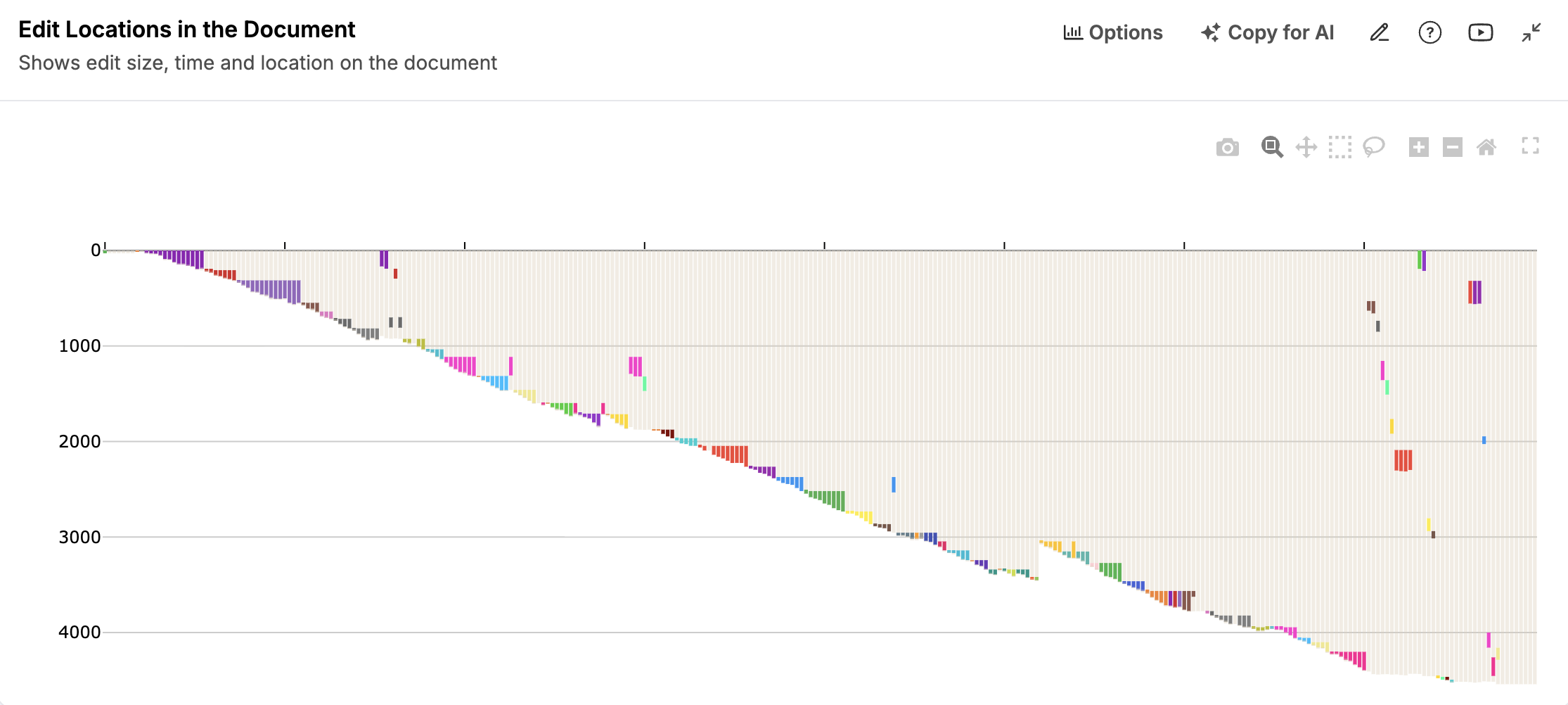
This very green graph is characteristic of what I call a “big pickle” essay. Often, its ratio of added to removed text corresponds to a very linear writing process. And that’s what I find in the other graph for this essay:
Chris Gortmaker
This graph presents the clearest visualization of how a student is revising—or not. In “big pickle” essays like this, students rarely work back over text they type into their document. The contrast with the earlier essay is clear. In fact, the earlier one with strong revision patterns was the next essay the student wrote after I found them using AI. Their writing came alive after we talked about their Process Feedback graphs.
Meetings to discuss prohibited AI use can be stressful for everyone involved. Process Feedback helps. By providing concrete evidence that’s meaningful beyond AI detection, it helps move the conversation through accusations and denials and toward talking about the writing itself.
When meeting with a student to discuss suspected AI use, I present evidence. I’m as clear and concise as possible, referring primarily to Process Feedback, but also a high-confidence Pangram report, if I have it. I set honest expectations. If I’m confident they used AI, I’ll say that given the evidence I have, there’s “little room for debate” and that they’ll have to rewrite the assignment or take a grade penalty, in line with our syllabus. I depersonalize. I emphasize that there are no hard feelings. And crucially, I establish value. I make it clear that what matters to me is that I encounter their thought in the take-home essay. I convey curiosity about their thinking, no matter how inchoate their writing about course material may be.
I’ve occasionally been mistaken about student AI use. Sometimes, scarce revision and a predilection for GPT-isms like three-part lists are reflective of how students have learned to write. In these cases, students immediately take up the “little room for debate” I offer them. That’s why this phrase is useful. We can then go on to have productive discussions about how to revise more and replace three-part lists with more precise phrasing.
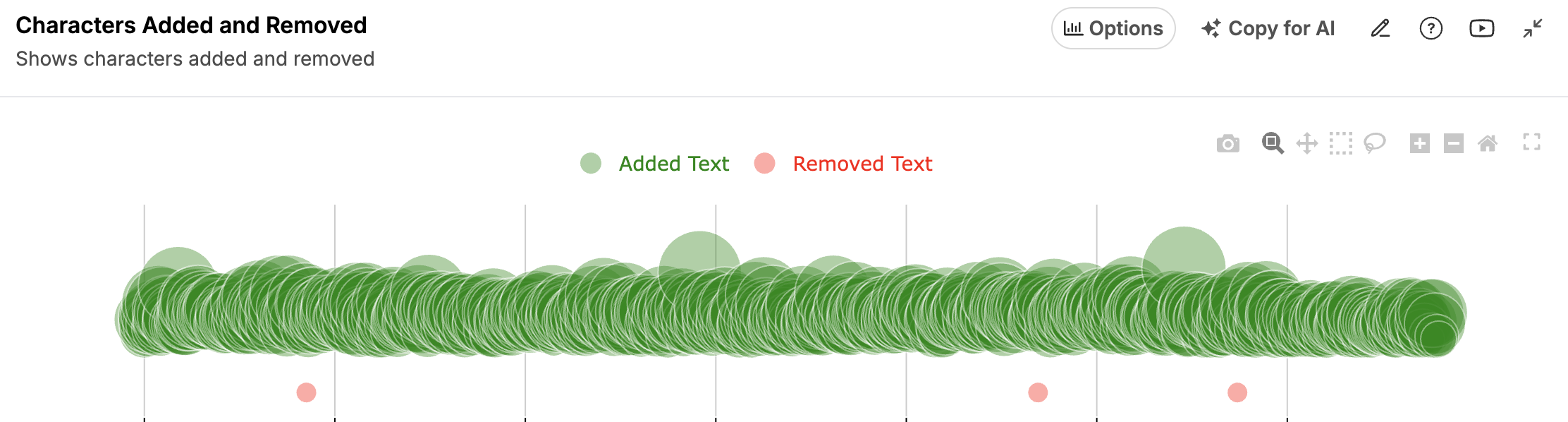
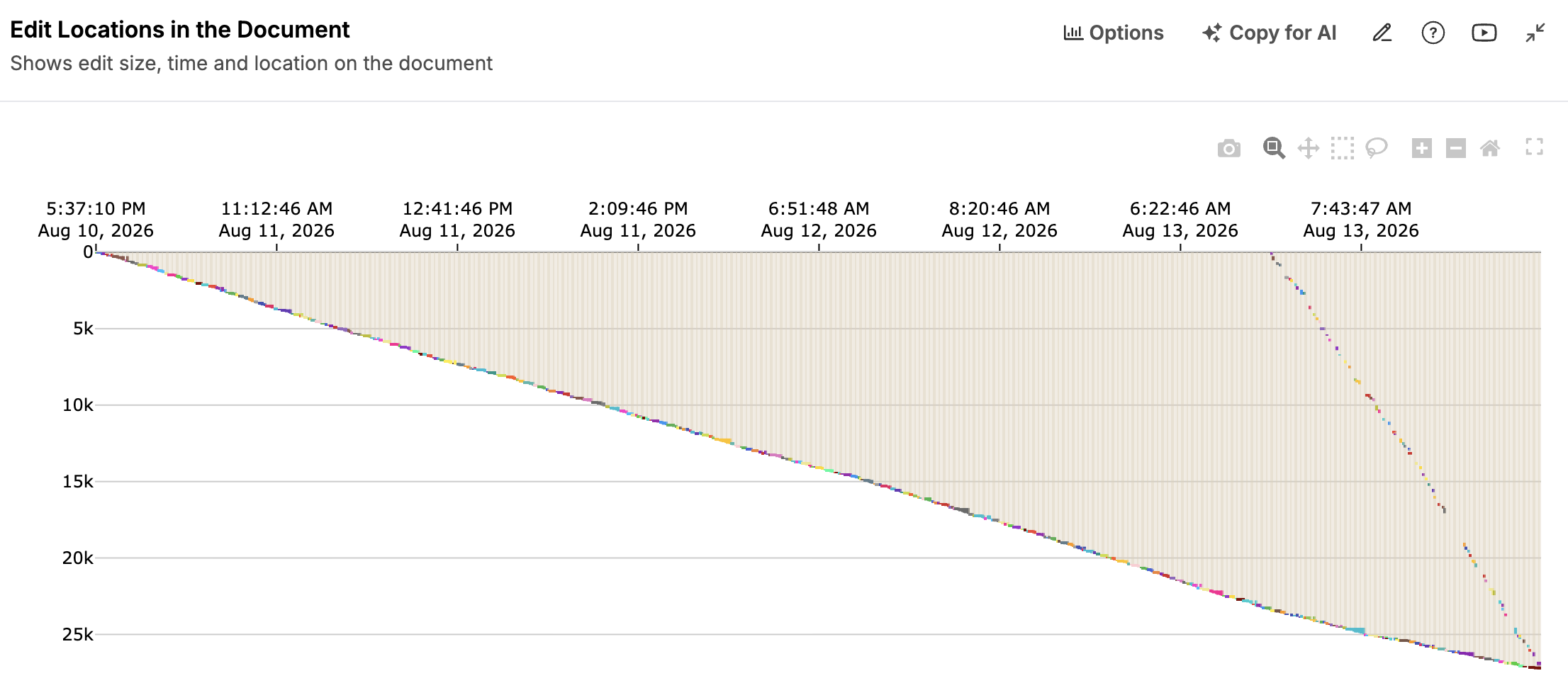
“Auto-typers” exist. These are programs that students can use to type AI-generated material into their Google Doc for them. While these programs might, in theory, undergo rapid improvements soon, the handwringing they’ve provoked is overblown. Top auto-typers like Duey.ai claim they can simulate authentic revision patterns, but it’s easy to see in Process Feedback that they can’t. I paid $9.99 and prompted Duey.ai to “type” a draft of this essay into a Google Doc over multiple “writing” sessions across three days. Here’s how this “writing” appears in Process Feedback:
Chris Gortmaker
Chris Gortmaker
Chris Gortmaker
That’s a big pickle and a ballistic process. Its simulated revisions might create enough noise to confuse a teacher looking through a Google Doc’s revision history without Process Feedback. But with this tool, the machine can’t yet hide.
Over all, Process Feedback sets the stage for honest and concrete conversations about AI and writing that become genuine learning moments for students. Unlike a Pangram report, a Process Feedback report demands complex interpretive judgements: noticing patterns, contextualizing patterns in relation to assignment prompts and expectations, comparing data visualizations to the final written product, and ultimately producing a holistic evaluation of process and product in conversation with a student. The conversation is key. With Process Feedback, we have more to talk about with our students—and students have more to talk about with each other.
I encourage students to download Process Feedback and share their writing processes with each other. For one essay, I have students formulate drafting plans where they block out time in their calendars for drafting and revision. After students receive feedback and a grade on their essay, they use Process Feedback to fill out a worksheet, reflecting on their time-management and revision practices. Peer review of Process Feedback reports in breakout groups produces a sense of competition that’s rooted in process rather than product: time-management skills and writing patterns rather than grades. “I didn’t realize you could revise that much!” one of my students exclaimed while looking at the cascading revisions in another student’s “Edit Locations in the Document” graph. “Sick waves, dude,” another remarked.
As they reflect together on the shapes of their writing processes and harp on just how difficult writing is, I’ve found that an esprit de corps emerges. Why? It may be rooted in the egalitarian thrill of demystification. Most of the writing that students have encountered in college is the work of highly accomplished writers, the product of waves upon waves of revisions (and anxiety) in response to editorial feedback. But students have little sense of this process, even as they measure their own writing against these finely wrought products. Before generative AI, it’s been easy for students to inherit the romantic idea of the writer as a spontaneous fount of brilliant words, or as a kind of totally determined word machine. In our age of AI, such mystifications may be tightening their grip. Every day, students watch chatbots spit out line after line of simulated linguistic fluency. Now as never before, it’s liberating for students to have the curtain pulled back on actual writing processes—for them to recognize that everyone struggles to write, and that this struggle is valuable.


