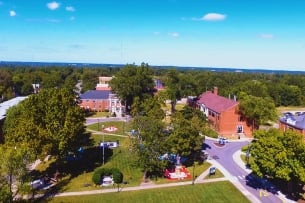
Canadian universities have been seeing steady growth in international enrollments, but only minimal interest from Americans, many of whom could potentially save a lot of money and (for those in some Northern states) enroll at institutions very close to home. An article in The Globe and Mail describes new efforts by some Canadian universities seeking to attract more American students. Special scholarships and increased marketing efforts are being tried by several universities.
Higher Education Quick Takes
Quick Takes
In today’s Academic Minute, Dale Durran of the University of Washington explains why it’s more difficult to keep your drink cold on a humid day. Learn more about the Academic Minute here.
The agency that accredits California's two-year colleges says that its review of the process it followed in evaluating City College of San Francisco found no irregularities, rebuffing allegations made last month in a complaint filed last month by several employee unions. The massive complaint filed by the unions made a wide range of charges against the Accrediting Commission for Community and Junior Colleges, including that the review of CCSF by the two-year arm of the Western Association of Schools and Colleges was tainted by conflicts of interest and in violation of state and federal laws. The report said the review by the commission's executive committee found the complaint to be "without merit." A spokesman for the California Federation of Teachers called the accreditor's report a "non-response" that was "completely predictable," and said the union was weighing its next steps.
Gordon Gee, president of Ohio State University, has apologized for comments he made about the University of Notre Dame and about Roman Catholics, the Associated Press reported. In a meeting of Ohio State's athletics council, a recording of which was obtained by AP, Gee said that Notre Dame wasn't invited to join the Big 10 because priests are not good partners, and "those damned Catholics" can't be trusted. He also said that "the fathers are holy on Sunday, and they're holy hell on the rest of the week." Ohio State issued a statement indicating that Gee had agreed to a "remediation plan" because of the remarks. Gee has personally apologized to officials at Notre Dame, who accepted the apology. Last year, Gee apologized to Polish-American groups after he compared the difficulty of managing the university to leading the Polish army.
Stanford University reported this week that it has made progress in diversifying its faculty. Between 2008 and 2013, the number of underrepresented minority faculty members (black, Latino and American Indian/Alaska Native) increased by 43 percent, to 146. During the same period, the overall growth in the Stanford faculty was only 9 percent. At the same time, the university said that a study based on interviews with 52 of the minority faculty members found areas that need improvement. Many minority faculty members, the university found, report feelings of research isolation, diminished peer recognition and "lesser collegiality."
Faculty members and some trustees are raising questions about why St. Mary's College of Maryland, well regarded for providing a public liberal arts education, missed its enrollment target for the fall's class by 150 students, The Washington Post reported. Some are criticizing President Joseph Urgo, who has said that the college will be cutting its budget to make up for the lost tuition revenue. Urgo has said that he is studying what happened and will make necessary changes, but many faculty members say he is responsible. They particularly note that Urgo has replaced most senior administrators since arriving three years ago, and that changes in the admissions office replaced people who knew Maryland high schools well.
More than 46,500 American students were pursuing full degrees abroad in 2011-12, according to a new report released by the Institute of International Education. This represented about a 5 percent increase from the year prior. Of those going abroad, about 42 percent are enrolled in bachelor’s and master’s degrees, respectively, with the remaining 16 percent pursuing doctorates.
The report is based on data from 14 countries, including the United Kingdom, the largest host of American students. (Other countries in the sample are Canada, France, Germany, New Zealand, Australia, China, the Netherlands, Ireland, Spain, Sweden, Japan, Denmark and Malaysia.) The numbers do not include students who study abroad as part of a course of study at a U.S. institution.
A new paper sponsored by several divestment advocacy groups and written by the Tellus Institute, a think tank that works on issues of sustainability, attempts to chart a course for institutions to follow in order to divest fossil fuel holdings from their endowments and overcome administrators' objections that divestment would be too costly and onerous. In the past few months, several university governing boards and endowments have become the target of a coordinated national campaign, which most wealthy institutions have so far resisted.
In the paper, author Josh Humphreys, a fellow at the Tellus Institute, who is this? -sj lays out a three-step path of freezing and divesting investments in coal companies, investing in renewable energy companies and "strategic reallocation across all asset classes in order to manage climate risk and embrace sustainable opportunities in a holistic way." The paper does not present any new calculations on the potential costs or benefits of divestment, instead relying on previous works, though it does express a belief that colleges that divest will likely see higher returns than institutions that continue to invest in fossil fuels.
On Thursday, Inside Higher Ed's editors, Scott Jaschik and Doug Lederman, discussed the latest developments and issues surrounding massive open online courses during a free webinar. To watch the webinar, which was held in conjunction with the recent release of "The MOOC Moment," a collection of articles and essays about MOOCs, click here.
In today’s Academic Minute, Michael Levin of Tufts University explains the process that determines organ placement as an embryo develops. Learn more about the Academic Minute here.