Beyond Transfer
This July marks Transfer Professionals Month, celebrating the college and university personnel championing transfer learners’ success. From admissions recruiters helping to demystify application processes to transfer advisers supporting learners in degree planning and transfer center staff and mentors promoting belonging every day, it takes many hands working together to ensure a smooth transition.
We also uplift those whose work is less visible: the transcript evaluators, registrars, deans and faculty advisers engaged in the behind-the-scenes work of learning evaluation. Learning evaluation—also known as credit evaluation—is the process whereby a learner’s prior college courses and other relevant learning are evaluated to determine if credit will be awarded and whether that credit will apply to their program of study.
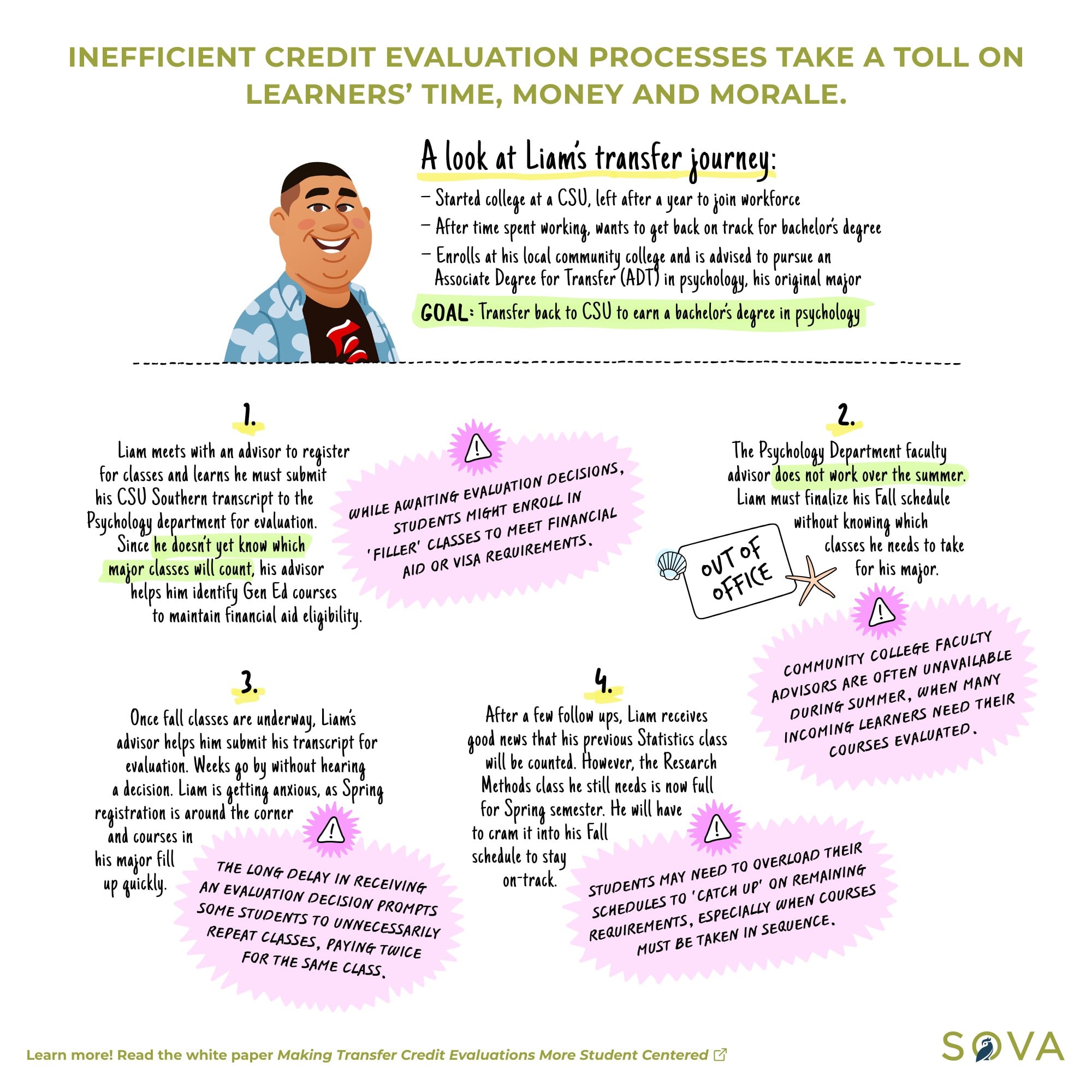
Learning-evaluation decisions are enormously consequential to learners, shaping how many classes they still need to reach graduation. Without timely evaluation, incoming learners can lose momentum and fall behind. Consider the learner journey below—a composite of real student testimonials that Sova documented in California.
Beyond Transfer
As central as their work is to student success, learning-evaluation professionals may feel disconnected from campus retention initiatives and policy tables. This may be because of how this work is distributed—typically split between the registrar’s office and academic departments—and the high volume of evaluations they must process, often on a manual basis. It can feel like there is little time to look up from the work, let alone to engage with colleagues in big-picture planning.
But it is in precisely this big-picture planning where the perspectives and insights of learning-evaluation professionals are sorely needed. For this reason, Sova and the American Association of Collegiate Registrars and Admissions Officers established the national Learning Evaluation and Recognition for the Next Generation (LEARN) Commission, a place where learning-evaluation professionals collaborated directly with accreditors, policy researchers and advocates to shape new guidelines for learning-evaluation policy and practice.
Over the course of two years, commissioners studied AACRAO membership survey data, held practitioner focus groups and consulted with experts on topics like high school dual-enrollment credit, credit for prior learning and applications of AI to support credit mobility.
They came away with the following assessment: Learning-evaluation policy and practice is working exactly as it was designed—as a mechanism for sorting out learning that is implicitly perceived as inferior. Confronting this uncomfortable truth is necessary if we are to build toward a different reality, one that values all relevant college-level learning regardless of where it was earned.
The LEARN Commission is now calling for a mindset shift: “Institutions and systems—and all involved constituents—should seek to maximize credential applicability and embrace the assumption that a learner is prepared for additional education, unless proven otherwise.”
But what does this mindset shift look like in practice, and how does one hold the big picture while simultaneously zeroing in on administrative processes? And what does leading change look like when you lack the positional authority to rewrite policy with the stroke of a pen?
In this week’s episode of Transfer Talks, we asked two commissioners to weigh in. Sarah Muller is assistant registrar at the Ohio State University, and Emily Kittrell is the transfer expert in residence at the National Resource Center on the First-Year Experience. Our conversation surfaced three takeaways for championing change as a learning-evaluation practitioner:
- Don’t assume that what’s set in policy should forever be set in stone.
When reviewing a student case, learning-evaluation policy is often invoked as a fixed, absolute rule. However, institutional policies were designed in response to dynamic situational needs. Consider just how much has changed in our landscape since our policies were first designed. For example, the profile of learners has changed drastically, and the ways they obtain relevant postsecondary training have greatly expanded. Seek to build a strong understanding of not just the letter of your campus policies, but the intent behind them. What specific problem is a policy seeking to address? Is this policy still functioning to solve that problem? Or has that problem evolved in such a way that renders our policies out of date?
- Document cases where the current policy, rule or standard operating procedure fails to adequately account for a learner need.
Slowing down to document these cases can be helpful for collaborative problem-solving with other colleagues. You might ask if others have observed similar cases and what is typically done to meet the learner where they are. For example, are learners routinely instructed to submit a petition to receive an exception? Is a manual override performed? Understanding how frequently these types of cases occur can shift the conversation from troubleshooting to strategy building. If these cases are not one-offs, it may be time to update a policy or revisit a long-standing practice.
- Look beyond your campus to imagine new possibilities.
How do we buoy ourselves up when the work feels difficult? By seeking out peers at other campuses and through formal networks. Perhaps your state or system convenes an association for registrars, for example, or you are drawn to connecting with others through an affinity or identity-based group. Are you a faculty evaluator eager to meet other faculty in this work? Accreditors are standing up those tables, too. Connecting with colleagues at other campuses can be a refreshing way to think beyond the common refrain of “that’s the way we have always done it” and may surface innovative ideas to share back with your own campus. Sometimes having clear proof that an alternative way is not only possible, but is already implemented elsewhere and can inspire action among those who are skeptical or risk-averse.
So this Transfer Professionals Month, we want to say: The work of learning evaluation matters now more than ever. To all engaged in this work: We see you and we thank you. If you’re looking for more inspiration on how to take action on your campus, we invite you to listen to the full Transfer Talks episode. Ready to roll up your sleeves and go further? Please join us at The Assembly in Arlington, Va., next week. Not able to join us in person? We’d still love to hear from you. You can share your feedback via this survey.