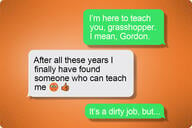
Justin Morrison/Inside Higher Ed
RST: Gordon, you have to stop complaining about how much I boss you around. You’re finally doing real work and all you do is complain.
EGG: One of the privileges of retiring is that I can now whine and complain, and I plan on catching up on 45 years of silence. So there!
RST: Well, I know you’re still getting used to not being the big cheese, my minion. What I’ve come to understand is that presidents can never be the victim. Once you start to share your troubles with those you’re responsible for leading, you might as well quit. That’s one of the reasons the job is so lonely. Y’all can’t really talk about how you’re feeling, and it’s your job to listen. One of the things I value about you, Gordon, is how well you do that. When we have conversations with presidents, you pay close attention and then always point out things you’ve heard them say. I think that’s a rare gift.
EGG: Thanks, boss. Listening is something I had to learn, and it’s hard. I suspect that I was like a lot of newly minted presidents who believed that I was given the position because I had more knowledge and ability than most other people. The arrogance of leadership is a real infection in the academy. I made so many mistakes because I had my own views already formed and only talked to people to be polite. How stupid! I can tell you that once I discovered the art of listening, my work became much better and I started to really lead with purpose.
RST: It takes a lot of confidence not to feel like you have to prove yourself. So, after a zillion years in the presidency, Grasshopper, you’re finally learning. Gold star for you. Here’s something I’ve been thinking about. Maybe I’m just paying more attention, or things have changed, but it seems to me many conversations feel more like games of jacks than like playing catch. We each take a turn, and keep going and going and going. Then we pass the ball to the other person, then they do the same. Do you notice this?
EGG: Interesting description. And I totally agree. It goes back to that dynamic of readily formed opinions so that the conversations become advocacy moments rather than a true exchange of ideas. If you know that someone has differing political views, there may be no real conversation. Rather, it is immediate jousting. The other day I had a colleague I had not seen for some time who came to visit. Almost the first thing she asked me was if I hated Trump. What the hell! How can we have any dialogue about anything if the parameters are already set?
RST: Oy. If she knew you better, she’d know you rarely say you hate anyone; you tend not to take things personally. That’s why, when it comes to discussing ideas, I’ve always loved being around physicists. Maybe it’s just the ones I know, but they will listen to someone, follow the argument and then say, “Here’s where you’re completely wrong.” They’ll explain their point and the other person will either say, “I see what I was missing” or “Nope. That’s not it.” No hurt feelings. Maybe it’s because my physicists like to play basketball and are not typical. And they know that even the best theories are right until proven wrong. I think my personality works better with people who don’t get bruised by my bluntness. Like you.
EGG: This may be a right brain/left brain phenomenon. My experience with scientists and engineers is that they have open minds about ideas because they have a methodology that is part of their training. Humanists are by the very nature of the craft dealing with shifting ideas. There is a wonderful podcast, The Rest Is History. Listening to these two Oxford dons, it is so apparent that the humanities are shifting sands informed by the times and the culture. And indeed we see that starkly now, when many humanists view history or literature through the lens of today. This concept of “presentism” is why, for example, there is such controversy around Civil War statues or individuals such as Thomas Jefferson, because they are being viewed through the present rather than their own times. There is a solidity to the scientific mind that requires great curiosity and tolerance.
RST: And there we go, plowing blithely into C. P. Snow–land and pissing off all my beloved colleagues in the beleaguered humanities. So, let’s regroup. When it comes to higher ed, I’ve been wondering how we can model good conversations. We have all been in groups where a couple of people do nearly all the talking. The rest of us sit silently, either listening or seething. What I learned early on in teaching is that if you’re the leader and you don’t interrupt that dynamic, not only will people in the group resent the big talkers, they will also hate you for not managing it.
EGG: I have already alluded to those who simply will not shut up. And lest I forget, my other pet peeve are the people you are talking with at an event who are constantly looking over your shoulder to see if there is a more important victim to engage.
RST: Welcome to my world. Now that you’re no longer the big cheese, you get to see how the rest of us live!
EGG: As a leader, you need to learn to read the room and body language. If conversations become diatribes or nonsense, you do the listeners no favor by not cutting this off. Of course, if you do it with cruel abruptness, you will chill the rest of the conversation. Maybe have a sock in your pocket that can easily fit into someone’s mouth.
RST: You told me you’ve just been sock shopping. We’ll be traveling to campuses next week. Is this a hint? Can you at least not wear them before you shove them in my mouth?
EGG: I have fresh socks ready for you.
RST: Phew. Getting a good discussion going is a rare skill. Those of us with lots of information we want to convey can get impatient to deliver it, often in one giant chunk. What I’ve tried to learn is that if I can wait, others will eventually make all the points I think need to be covered. I’m still hoping to learn that trick of responding, when someone says something really dumb, “That is so fascinating.”
EGG: Let me put it more directly: Leading a good discussion is a necessary skill. And one that requires preparation if it is in a more formal setting. Socrates did not just ask questions; he came prepared to discuss issues. One of the deficits in higher education is often that we do not come prepared to be thoughtful and inquisitive. Rather, we carry our biases into the circle and divert any meaningful conversation by asking preordained questions that dampen any wide-ranging dialogue.
RST: But we are not trained in discussion, and most of us don’t practice it. Not in regular life and not on campuses. We’ve long known that the lecture is not a good format to get people to absorb new information, and yet we keep teaching that way. For a while, we talked about the flipped classroom. But in my daily conversations, I’m often frustrated because it feels like we’re all (and I include myself here) just alternating lectures. Sometimes I have to Burr myself and sing, “Talk less, smile more.”
EGG: Rachel, there is no substitute for genuine, open-ended and open-minded discussions with ourselves and our students. We should have learned that from our friends Aristotle, Socrates and Plato.
RST: The thing I worry most about these days is that I’m seeing a lack of curiosity everywhere I look. It’s not just students who want to know the “right” answer, but in so many other places where no one is really asking questions of other people. I’ve become allergic to certainty, and so I’m constantly itchy.
EGG: Certainly that allergy is not prevalent in our talking heads.
RST: Let’s keep each other from becoming those kinds of talking heads. Friends don’t let friends mansplain.