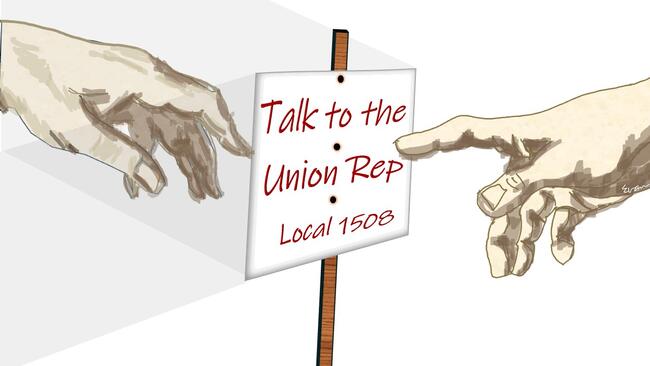
Drawing by the author, Evan D. Morris.
“Have a nice weekend, Mike. I’m off to Florence to see the latest by the scribbler, Macky Velli. The ceiling is really shaping up. You’ll be done in no time. BTW—Please remind Big Pappy that my salary will be increasing July 1. Union orders.—A. Prentiss”
Such is the sticky note that might have been left by an ungrateful and transactional apprentice to Michelangelo while grinding paints and learning fresco painting from the master.
Thankfully, there were no fresco painters’ apprentice unions in 1508. And the world has enjoyed the incomparable Sistine Chapel since.
Unfortunately, in 2026, postdoc unions are proliferating. And because of them, a key element of training for young scientists may be doomed.
Postdoctoral fellows working in research labs are also apprentices—and one need not argue that all lab directors are geniuses on par with Michelangelo to appreciate the point that being a postdoc is the best way to learn our craft and progress toward an independent career in science. New postdocs are not yet wise in the ways of organizing and building an independent research operation. Most are not yet able to secure large grants (commissions, in Michelangelo’s time). They don’t yet have the name recognition, résumé or network for success. The value of a good postdoctoral fellowship is not to be measured in salary but in the opportunity to learn at the feet of, yes, a master.
If we allow unions to commoditize the work of postdocs, we begin to undermine a key facet of their training, and one that is often credited for their future success: mentorship. Good mentorship is multifactorial. As a lab director, I may introduce you to my friends, advise you on your career path and write you letters of recommendation. But it also means taking an interest in you, your career, your family and your mental health. It means helping you identify your strengths and weaknesses, how to leverage the former and overcome the latter. It means holding meetings in parks when the offices are closed by COVID, or inviting you for Thanksgiving dinner when you cannot go home for the holiday. These aspects of good mentorship are both personal and unquantifiable. Now, sadly, into the personal milieu between mentor and mentee come the unions.
Is unionization of postdocs on the rise? Yes. Has there been much thoughtful discussion in the scientific community of the consequences? No. On March 26, the Yale University faculty were notified of an impending vote on unionization by postdocs—but no date for a vote was announced. A second email, on April 20, announced the election on April 29 and April 30. No comments were solicited. So much for seeking informed opinions before acting. On May 1, we received a third email from the provost. Not surprisingly, the postdocs had voted to unionize. In a tally reminiscent of Pravda, we were informed the vote was 859 to 31. So much for diversity of thought.
One would hope the union will confine its activities to advocating for shorter work hours and better pay, stay out of Middle East politics, and eschew Israel-bashing. We can hope. But even if it sticks to a conventional union mission, it doesn’t belong mucking about in what is a collection of individual relationships. They are not one-size-fits-all. Being a postdoc in a laboratory at a Yale or a Harvard is a rare and valuable opportunity to be tutored by a master.
Thinking of interactions with my own mentors, these were singular and personal relationships. I have asked for advice throughout my career—just as my mentees have asked me. If my input or name can help them secure a new opportunity 25 years after we worked together, then I give it. No questions asked. This is nothing like working the late shift on a shop floor or in a burger joint. If you’re still calling your boss 25 years after you worked at Burger King, I’d love to know about it. But if you’re my postdoc and you declare that you won’t work when we are up against a deadline or won’t help when I’m working over the weekend to support our shared glory, then don’t expect that invitation for Thanksgiving. I don’t invite the guy who charges me by the hour to cut my lawn. I invite my friends.
Postdocs get the chance to observe their mentors at work. The lessons can be grand and not so grand. It is awfully hard to succeed. It takes total commitment. In Apprentice to Genius: The Making of a Scientific Dynasty (Macmillan, 1986) Robert Kanigel cites the knack for identifying a ripe and impactful but solvable problem as a special quality that great scientists seem to have and sometimes pass to their mentees.
Some of the pearls I picked up from my mentors: Never give a presentation without a clear story; break all problems down to their (mathematical) basics; after a long day at a conference, go directly back to the hotel room and write down everything you learned.
As the healthy mentor-mentee relationship matures, the transmission of information becomes bidirectional. Eventually, knowledge-sharing and joint accomplishment grow into a partnership between colleagues. Real partnership leads to sustained friendship. In my case, we are still friends and in contact 30 or 40 years after we met.
Science, like painting the Sistine Chapel, is not a 9-to-5 job. But it is a type of contract work. The pope gave Michelangelo a commission and he had to make do: buy the paints, the plaster, build the scaffolding. When the National Institutes of Health gives me a grant, there’s a preapproved budget. The salaries for postdocs are fixed. A union can make all the demands it wants for raises. But to get them, they may have to print the money. Once the grant is awarded, the government won’t give me more money—and it usually gives me less.
What about bad postdoc mentors? Not all scientists are good mentors to their trainees. But even when this occurs—and it is regrettable—it is not something that a union can fix. The union cannot make the professor sympathetic or interested in the postdoc’s life or career path. It cannot force the professor to become a friend or confidant.
And yet, the poorly treated postdoc is not without options. He is not an indentured servant. If worse comes to absolute worst, he can leave the lab. There is no doctoral degree hanging in the balance (as for the graduate student), giving all the leverage to the professor. Sure, leaving would be disruptive. But life is not guaranteed to be stress-free. Before exiting, though, there are interim steps that can be taken—and they are best taken as an individual. Join a postdoc group for guidance and support. Seek secondary mentors. Advocate for yourself! Make the case to the boss for time off to recharge. Request introductions to colleagues at conferences. Discuss ownership, publishability and trajectories of projects from early on. These may be difficult conversations, but they are what professionals must do if they hope to establish themselves in their chosen, highly competitive field.
Sometimes an arrangement simply cannot be salvaged by a heart-to-heart. I lived through one of those situations as a postdoc at Harvard many years ago. The friction was not between me and my mentor but with the big boss. One day, Mr. Big went on an unprovoked rampage and told me to “clean out my desk.” Everyone in the group was stunned. I walked out. But only long enough for the panic to subside. Then I asked for an appointment with the department chair. I made my case. Senior colleagues who had witnessed the rampage chimed in to support me and my depiction of events. Mr. Big apologized. We moved on. It was very unpleasant. But what would a union have done? Caused everyone to dig in their heels. Unionization will not solve bad mentorship. But it will poison the well of the good.
Unions are about treating everyone, every problem and every circumstance exactly the same according to union rules. But the mentor-mentee relationship is the ultimate bespoke and personal relationship. What is passed from the mentor to the mentee is not something that can be codified or regulated—especially not by groups focused on hours of sick leave or retirement benefits. In its highest form, the intangible that is transmitted is greatness. Kanigel cites the large number of Nobelists whose mentees went on to the Nobel themselves. The best attract the best. This is how science—a meritocracy—works and ought to work to produce the most groundbreaking and impactful discoveries. Whatever secrets or expectations or demands or admonitions were passed between Luria and Watson or between Bohr and Heisenberg or (at a more pedestrian level) between me and my mentors and me and my trainees, unions should have no say.


