
The Apprentice: Why Higher Ed Is Leaning Into Earn-and-Learn
Colleges are facing a “perfect storm.” Is adding apprenticeship pathways a way through?
Photo illustration by Justin Morrison/Inside Higher Ed | nautiluz56, monkeybusinessimages, mediaphotos and The best photo for all/iStock/Getty Images
Apprenticeship is trending in the U.S., but it’s had similar moments before and failed to scale. Many experts think this time will be different.
VUCA: volatility, uncertainty, complexity and ambiguity. It’s a management acronym popularized by the U.S. military to describe the changing world after the Cold War. But Minah Woo, vice president of workforce innovation and strategic partnerships at Howard Community College in Maryland, said it accurately describes the current operating environment for higher education.

“We are dealing with a lot of things happening all at once,” Woo said, “and it’s requiring us to think outside the box and be agile.”
One solution? Apprenticeship. It’s not an innovation, per se, since apprenticeships predate the modern university by centuries. But many institutions are helping reimagine what an apprenticeship can be and whom it can be for. And, in so doing, they’re reimagining the interplay between higher education and the workforce and how learners can obtain a credential of value. Today’s apprenticeship programs span not only the skilled trades but fields from nursing and teaching to cybersecurity. And while apprenticeships can and do exist outside of higher education, they’re increasingly offered for credit, or embedded within degree pathways.
Take Howard Community College. Recalling the launch of the institution’s first apprenticeship, Woo said that some skeptics doubted a skilled trade program would take hold locally in one of the nation’s most affluent counties. So she planned for just five apprentices in that first HVAC cohort in 2018. She got 24.
Today, Woo estimates the college is training more than 200 apprentices in the skilled trades, from HVAC to electrician to plumbing. With the support of her president and other colleagues, Woo has also launched registered apprenticeships in fields including construction management, licensed practical nursing, surgical technology, professional childcare, information technology and accounting.
Most of the college’s apprenticeships offer credit—skilled trades apprentices can earn up to 27 credits toward an associate degree in applied science, for instance—and all terminate in an industry-recognized credential. Fundamental to the model, the apprentice is not only learner but a paid, mentored employee of an employer partner throughout their training.
“Our philosophy is that we are adopting the apprenticeship model that has been around for ages in the skilled trades and using that model and converting it into nontraditional areas,” Woo said. “We now have faculty members come and say, ‘Hey, do you think our program could be part of the apprentice model?’ And we’re here going, ‘Of course!’ We welcome them.”
Having a Moment—but Why Now?
It makes sense that apprenticeships are resurgent in higher education’s VUCA era, amid concerns about college value, affordability, political and economic uncertainty, demographic change, technological displacement, and the narrowing unemployment gap between high school and college graduates. But apprenticeships have had moments before and failed to scale to the extent that they have in other countries: In the U.S., apprentices hover at about 0.3 percent of the working-age population, versus closer to 2 to 3 percent in nations such as the United Kingdom, Germany and Australia—where governments, education systems, industry and cultural attitudes are more supportive of apprenticeship pathways. Half of all Germans between the ages of 18 and 24 are apprentices, compared to 2 percent of U.S. young adults, according to an analysis by the think tank Third Way.
Here, as education and workforce expert Anthony Carnevale once put it, the model is “high school to Harvard.”
Still, the number of active participants in U.S. registered apprenticeship programs more than doubled between 2014 and 2024, to nearly 680,000, according to a separate 2025 analysis of federal data. The annual number of graduates from registered apprenticeship programs reportedly grew by 143 percent over the same decade, from about 46,000 completers to nearly 112,000.
Joe Ross, president and CEO of Reach University, thinks this moment for apprenticeships will be different. He’s also betting on it: Reach is the country’s only nonprofit accredited university dedicated to apprenticeship degrees. Its apprentices are largely working in education and health care so far. “I can count on hospitals having a shortage of nurses, and I can count on schools having a shortage of teachers” and on both workplaces having nondegreed employees who want to keep working up to full-time while they train for degreed roles, he explained. Many Reach apprentices training to be teachers work in K–12 special education programs as paraeducators.
While Ross called higher education’s current set of challenges a “perfect storm,” he described what comes next as a paradigm shift rather than a decline.
“Higher education has a major transformation, or a minor revolution, every generation or so, every 20 years—and a major revolution every century,” he said, citing higher education scholar John Thelin as one influence on his thinking. “And I think the story of this century will be that the workplace is going to become the college campus, and that higher education is going to become work-embedded at scale.”
I think the story of this century will be that the workplace is going to become the college campus, and that higher education is going to become work-embedded at scale.”
—Joe Ross, president and CEO of Reach University
Ryan Craig, author of the 2023 book Apprentice Nation: How the “Earn and Learn” Alternative to Higher Education Will Create a Stronger and Fairer America and co-founder of the nonprofit Apprenticeships for America (AFA), estimated that the U.S. is five years away from finally reaching parity with other model nations in terms of apprenticeships as a share of jobs. He credited that timeline to the Trump administration’s recent announcement of $145 million to support a pay-for-performance incentive program to expand the national apprenticeship system.
Prior to this development, Craig and other apprenticeship advocates had expressed disappointment in the levels of tangible support that followed Trump’s April executive order to “reach and surpass” one million new active apprentices. But Craig described the new program as a sea change in the way America funds apprenticeships.
“My expectation—consistent with the experience of other countries—is that predictable, formula-based, pay-for-success funding demonstrates much greater efficacy in prompting employers and intermediaries to launch apprenticeship programs and hire apprentices,” he said.
AFA has urged Congress to take action to solidify this approach, instead of continuing to rely on the “bespoke grant programs” that have helped grow apprenticeship programs but not scale them.
The Labor Department on Friday released grant details about the pay-for-performance incentives program. Labor will award up to five cooperative agreements, four with a focus on rapid registered apprenticeship expansion, by offering incentive payments to program sponsors for all new apprentices. Targeted industries for those four grants are shipbuilding and defense industrial base; artificial intelligence, semiconductor and nuclear energy infrastructure; information technology; health care; transportation; and telecommunication.
For colleges and universities, apprenticeship advocates also see some related technical instruction funding potential in Workforce Pell. That’s the extension of the federal Pell Grant program to high-quality short-term programs under the One Big Beautiful Bill Act. And some see apprenticeship potential in the sliver of high-demand academic programs with clear social value but low wages (think early-childhood education) that may bump up against the law’s new earnings test. Concerns about K–12 teaching being a high-demand, lower-wage field with traditionally high training costs have already driven growth in registered teacher apprenticeships in nearly every state.
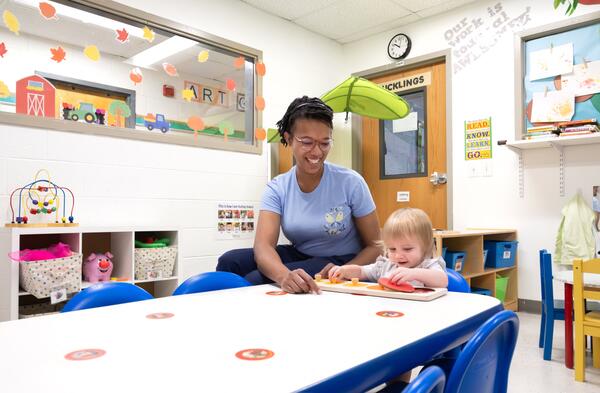
Jessica Guillory, a childcare professional apprentice at Howard Community College, works at the Cradlerock Children’s Center in Columbia, Md.
Howard Community College
If these developments are the carrot, there’s also a stick: Craig predicted the widening experience gap for entry-level workers in the age of AI will force apprenticeship expansion.
“Unemployment and underemployment for 20-something college grads is going to spike because of AI,” Craig said. “That’s going to become clear within a couple of years, and that will elevate apprenticeship out of the morass of workforce ‘train-and-pray’ that it’s been stuck in for the last few decades.”
Apprenticeships, he continued, “are not training programs, they’re jobs, and they are a big part of the answer to the current and future crisis of career launch and economic mobility.”
Ron Hetrick, senior labor economist at Lightcast, is less confident that AI itself will displace workers at scale anytime soon, outside of especially exposed industries. He’s similarly suspicious of headlines proclaiming Gen Z as America’s “tool-belt generation,” citing his own research documenting young workers’ concerns about physical labor and nonoffice jobs. But he does acknowledge a huge skilled labor shortage—one that may be exacerbated by U.S. immigration policy, he said—and a growing imperative for higher education to embed work-based learning in every pathway. He’s endorsed both internships and apprenticeships as powerful ways in which businesses can win early talent.
“Should we be looking at apprenticeship in every industry? Yes,” Hetrick said. “There are so many problems that are solved by getting people working while they’re doing degrees. The concept of pure classroom training at this point almost feels absurd, right?”
According to Inside Higher Ed’s forthcoming 2026 Survey of College and University Presidents, 37 percent of 430 total respondents’ institutions are looking to add or expand apprenticeship pathways in the next three years. Among community college presidents in the survey, the rate is 64 percent. Even 19 percent of all private nonprofit institution presidents and 30 percent of four-year public institution presidents report interest in adding apprenticeships.
Apprenticeship is also a rare area of bipartisan agreement, with states across the country working to develop or expand their own apprenticeship infrastructures. Jack Porter, program director for the National Governors Association’s workforce development and economic policy program, said that apprenticeships are “an increasingly popular workforce development tool for governors and for bipartisan policy action.” The association’s current chair, Oklahoma governor Kevin Stitt, a Republican, has launched a yearlong initiative focused in part on youth apprenticeship and career-connected learning. This involved a delegation trip to Switzerland, where approaching 4 percent of the working-age population are apprentices, with Delaware governor Matt Meyer, a Democrat.
At home in Oklahoma, Stitt has challenged leaders to add 250 apprenticeships this year. Meyer’s first executive order as governor was to create a working group on boosting apprenticeships in Delaware, including via “the expansion of work-based learning programs that operate in partnership between state agencies and local education agencies and postsecondary institutions.” His order highlighted registered apprenticeship program opportunities in state agencies and other “vital” industries, such as health care, construction, advanced manufacturing, information technology, finance and clean and renewable energy.
Kathleen deLaski, author of the 2025 book Who Needs College Anymore? Imagining a Future Where Degrees Won’t Matter and founder of the Education Design Lab, said learners themselves are hungry for more options. “Learners are trying to vote with their feet for other forms of higher education, but we haven’t greased the pathways or scaled them or funded them or evaluated them in ways to make them available,” she said, citing apprenticeships and industry-recognized credentials as the two most effective nondegree pathways to helping people reach family-sustaining careers.
Learner demand still outpaces available opportunities in many locations and fields, but apprenticeship numbers continue to grow. North Carolina, with one of the nation’s most robust apprenticeship systems, saw record growth in 2024–25, with 16,446 total apprentices served, 5,241 new enrollments and 3,224 employers engaged. Apprenticeship completion rates hit 69 percent, and 90 percent of past completers were still with the same employer five years later, according to ApprenticeshipNC, the state’s apprenticeship agency, which is part of the North Carolina Community College System.
Wake Technical Community College, based in Raleigh, has seen this boom up close. President Scott Ralls said the college expanded from about 15 employer partnerships six years ago to 177 today, with most under the college’s direct sponsorship, or administrative remit. “We’ve had a tenfold increase in the number of employers we work with, and this is all registered apprenticeship,” he said.

Apprentices enrolled in Amgen’s apprenticeship program at Wake Technical Community College in North Carolina earn while they learn biotechnology skills.
Wake Tech Community College
California is also bullish on apprenticeships, with Governor Gavin Newsom setting a goal of 500,000 apprentices by 2029. This builds on infrastructure established when the state’s apprenticeship program shifted to the California Community Colleges chancellor’s office in 2013.
“That was a structural turning point where community colleges were, in a formal way, recognized as the primary public education partner for apprenticeship,” explained Sonya Christian, CCC chancellor. “We invest about $12,000 per apprentice—that’s the ratio when we’re looking at our budget request to the state. And the state, on a recurring basis, invests $130 million to support the apprenticeship work, which is a multisector engagement.”
Work-based learning is a “huge part of our Vision 2030, which is the road map for California Community Colleges,” Christian added. “And apprenticeship is the gold standard, right?”
Defining Terms: What Makes an Apprenticeship?
As interest has surged, so has confusion about terminology: What’s the difference between an internship and an apprenticeship, for example?
Annelies Goger, a fellow at Brookings Metro, offered a clear distinction: “An intern at a winery would probably help with some tastings, clean up, meet people and network, observe, see what roles there are.” An apprentice, meanwhile, “works very closely under the supervision of the person making the wine. And by the end of the program, they know how to make wine. They come out professionally—they know how to do it. It’s equivalent to at least an associate’s degree level or bachelor’s level in terms of how much that person knows.”
Goger wasn’t knocking internships, especially paid ones, as they continue to offer learners many benefits, including a measurable advantage in the hiring market. But internships are part of a student’s larger experience, not the locus of their extended training. Internships may last a summer or a semester. Many apprenticeships last two to four years.
In cooperative education, or co-ops—another kind of work-based learning—students typically alternate between semesters in the classroom and semesters in the workplace.
In apprenticeships, by contrast, structured learning centers on work, supplemented by related technical instruction. Apprenticeships can operate on a time- or competency-based framework, or a hybrid of both. But the widely used federal standard for time-credited registered apprenticeships is 2,000 hours of on-the-job learning and 144 hours of related instruction per year. The related instruction can be delivered outside of higher education, such as through a trade union. But again, increasingly, colleges and universities are taking up this mantle.
Another key feature of apprenticeships: They’re paid jobs from day one. As Chris Harrington, director of ApprenticeshipNC, told Inside Higher Ed, “If they’re not an employee, they’re not an apprentice.”
Wages generally progress as the apprentice becomes more skilled. According to the 2025 analysis of federal data, from 2019 through 2022, the average entering apprentice across sectors earned $18 per hour. The average completing apprentice earned $32 per hour, equivalent to about $66,000 in annual wages for an apprentice completer employed full-time. Apprentices who left their programs without finishing also boosted their average hourly earnings, but by smaller amounts. A separate 2025 analysis from the Government Accountability Office found that between April 2022 and March 2023, registered apprenticeship completers earned average annual wages of about $80,000 their first year out, higher than wages for associate degree holders.
Most programs are also designed to be debt-free. Apprenticeship programs achieve this and otherwise operate on what’s called braided funding: Multiple streams of public and private dollars are woven together to support wages, instruction, support services and administrative costs. At Reach, for example, students pay $75 a month maximum out of pocket, or $900 a year for four years, with other costs covered by Pell Grants, workforce training dollars, employer contributions and even philanthropy; the exact formula changes by student, state and occupation.
“The consequence of this braided revenue strategy is that the return on investment calculation is very different,” Ross explained. “In the past we were looking at, ‘Are you getting return on $80,000 of debt?’ Now my question for the learner is ‘Are you getting return on $3,600 total cost?’ And if you’re the government agency that is contributing $2,000, the question is ‘Are you getting the social good return on $2,000 a year, or $8,000 total for a degree?’”
In another example of how funding can work, any North Carolina student signed on to a registered apprenticeship before graduating high school, or in a pre-apprenticeship preparation program with subsequent enrollment in an apprenticeship, sees related technical instructional costs at a community college waived. Harrington said this is “good for the individual, but it’s really good for the employer, because in most cases employers would be funding this. It mitigates some of their risk.”
Crucially, apprenticeships also end in the trainee earning an industry-recognized credential. This can include a journeyman’s certificate indicating mastery of a trade, a national occupational credential and/or a degree, in the case of degree apprenticeships.
“Earn and learn is the key operating principle here,” Porter, of the National Governors Association, reiterated. “Apprenticeships are jobs that lead to a national, recognized credential. And they combine highly relevant classroom education with paid work experience.”
An apprentice is the person who works very closely under the supervision of the person making the wine. And by the end of the program, they know how to make wine.”
—Annelies Goger, fellow at Brookings Metro
Another key question: What’s the difference between what are sometimes grouped as “little-‘a’” and “big-‘A’” apprenticeships? The latter are registered with the Labor Department or state apprenticeship agencies, while the former are not. As for whether that’s a meaningful distinction, the answer is nuanced: Registration ensures high quality standards and portability—these apprentices can take their credentials anywhere—but also involves regulatory complexity that can deter employers.
Holly Smith, executive director of the National Center for the Apprenticeship Degree, housed at Reach, was pragmatic: “We always design with registered apprenticeship standards in mind. That doesn’t mean a partner is going to launch their apprenticeship degree as a registered apprenticeship, but it means they’re ready to.”
In higher education settings, the registration question sometimes comes down to context. Health care, teaching, social work and other licensed professions may benefit most from registration because it “protects the learner, creates a consistent and portable credential, and enables public investment and employer confidence,” said Smith, whose center recently worked with Metropolitan State University of Denver to launch a master’s degree–level social work apprenticeship pilot. This is the first time the Labor Department has recognized social work as a registered apprenticeship occupation, according to the center. The pathway is now in the final stages of classification as a registered apprenticeship program.

Matthew Bustos is one of 20 apprentices working toward a master’s degree in social work as part of an apprenticeship pathway pilot program at Metropolitan State University of Denver.
Tiffany Miller, dean of apprenticeships at West Los Angeles College, said sometimes the registration circle just won’t square. Case in point: Apprenticeships involving one of the city’s largest employers, the entertainment industry. “They’re not registered because their model is so different—50 hours on this set, 60 hours on this set, and then they get union jobs, and it’s great … Everyone wants to be registered for the incentives, but if the employers are getting what they need and underserved Californians are getting better jobs, that’s all that matters,” she said.
Craig was critical of the “burdensome” registration process, especially for nontraditional apprenticeships. It’s “an application process that is driven by apprenticeship’s history in the trades, where safety issues are obviously paramount,” he said. But to something like a cybersecurity company, “It’s pure bureaucracy.”
The even bigger problem, Craig continued, is that registration has no direct connection to funding, “unlike every other country, where you register your program and funding flows to the employer and ultimately to the apprentices as a result.”
Registration in the U.S. does open doors to various funding opportunities, tax credits and resources, however.
The Scaling Problem: Why America Lags Behind
Red tape and inconsistent funding are two reasons the United States remains far behind international peers on apprenticeships.
Craig ultimately wants to see “pay-per-apprentice” funding, “where every time you hire and train an apprentice, you get paid. That is how England and Australia pulled way ahead of us.”
Cultural barriers factor in, too. Goger, of Brookings Metro, said, “We have this legacy of tracking, and this legacy of saying that it’s other people’s kids who do apprenticeship, right? ‘It’s not my kid. I want my kid to go to Harvard.’” This ignores the evidence of strong outcomes for apprentices, but also the possibility of intentionally designed pathways that allow learners to move between vocational and academic tracks, Goger said—what some experts call “permeability.” By contrast, Switzerland has “been really thoughtful about making sure you can move between pathways without having to start over. We haven’t built those on-ramps and off-ramps.”
Swiss learners who do move between pathways often have the best outcomes, because employers value both “deep theoretical grounding and more practical experience,” Goger added.
One Brookings analysis of apprenticeship programs in five peer nations identified three traits across successfully scaled systems: technology-enabled tracking that links outcomes to policy, national standards that make credentials portable and incentives that help both apprentices and businesses stay engaged.
Harrington emphasized the challenge of industry buy-in in the U.S. “Many employers still have not come to the understanding that they have to help co-develop the talent, they can no longer be just consumers of talent,” he said. Employers also hire apprentices for their future skill set, so businesses are “making a projection based on a future need. If it’s a four-year training program, they have to look out four years and estimate how many people they’ll need. Most employers aren’t looking much more than six or 12 months out.” Smaller businesses—the vast majority of employers—may feel this most acutely.
If they’re not an employee, they’re not an apprentice.”
—Chris Harrington, director of ApprenticeshipNC
Woo, of Howard Community College, agreed that “employers are committing to hire these people as full-time employees and keep them on their payroll. That’s a huge commitment.” Yet there’s often a payoff for employers who do make this investment. One small federal study of registered apprenticeships found that the median return on investment was 44.3 percent, meaning that every $100 an employer invested in apprenticeship generated $144.30 in total benefits. Counting both direct and indirect benefits, two in three employers recouped their investments during the period after their apprentice completed the program. In that study, among others, apprenticeship was linked to factors such as improved company culture, pipeline of skilled workers and employee loyalty.
State incentives can help bring employers on board, Harrington said, making the economic case for investing in training more tax-paying workers: His agency estimates that 52,000 completers by 2034 would produce more than $2 billion in additional wages and $268 million in incremental tax revenue. Another study focused on Washington found the 10-year taxpayer return on investment in apprenticeships was $7.80 for every $1 invested. In Maryland’s state-incentive program, apprenticeship sponsors and employers are eligible for up to $3,000 per adult registered apprentice, or $7,500 per high school–age registered apprentice.
Intermediaries, or organizations that help support, scale and coordinate apprenticeships, can also assist, especially in recruiting employers. A note: Some colleges act as intermediaries, just as some colleges act as apprenticeship sponsors, though a sponsor is mandatory for registered apprenticeships, while an intermediary is not. However, intermediaries can play a large role in apprenticeship operation, reducing the administrative or even financial burden on the training employer, depending on how funds are braided.
Another barrier to scale, where higher education is involved, is the traditional American semester- and campus-based model. It’s not accommodating to working adults who may need evening or blocked classes, accelerated schedules and credit for work-based learning, experts said. Yet many institutions are already working to better serve modern learners, offering these accommodations even outside of apprenticeship contexts.
Liz Qualman, director of teacher education at Colorado Mountain College, said that designing training for her teacher apprentice cohorts “is a big lift in terms of scheduling, reworking coursework to include on-the-job training, really making competencies clear—because that’s a Department of Labor thing—and having faculty that can shift their mindset from what’s a very traditional pathway to this more work-based pathway.” But the college was already shifting to eight-week terms in some disciplines, she said, making it easier for apprentices to take lighter course loads (just two at a time) while working. Courses are offered online, as well, to accommodate apprentices working across the state.
At Wake Tech, many apprentices in the skilled trades, transportation and biotechnology take classes two days per week and work the other three days.
Not an Either-Or
Despite the energy around apprenticeships, most advocates reject the idea that they should replace or even compete with traditional degrees. The point, experts said, is offering more learners more pathways to a better life.
“We’re approaching it from an abundance mindset,” said Christian of California Community Colleges. “There’s so much of a workforce need out there and we have to be able to, from a higher education standpoint, provide that economic mobility. But bringing in apprenticeship and recognizing that learning is happening outside of the academic enterprise does not mean subtracting the number of faculty or courses that we are offering.” Apprenticeship can also bring more people into academe, she said: “Think of someone who is a journeyperson who did not come through higher education, and now they’re 35 years old and they want a supervisory role. This creates an on-ramp and an additional enrollee.”
Smith, who studies and facilitates apprenticeship degrees, said that apprenticeship degrees don’t undermine traditional higher education but rather “modernize and lift higher ed. They’re embedding credit for work, employer partnership and curriculum alignment directly into the degree, rather than treating it as an add-on.”
We’re approaching it from an abundance mindset.”
—Sonya Christian, chancellor of California Community Colleges
Harrington did bristle somewhat at the term “apprenticeship degree,” lest it suggest that an apprenticeship terminating in another credential isn’t enough. And as higher education leans into apprenticeship, it will be important for it not to impose its own baggage on the model—not just a bias toward degrees for learners who don’t want or need them, but also common criticisms such as seat-time requirements that can privilege classrooms over competencies and administrative processes that can slow learner momentum.
At the same time, many experts agree that colleges are well suited to scale apprenticeship by bringing their administrative, instructional and workforce prowess to the table, including as sponsors and even intermediaries. Community colleges are particularly savvy in workforce development.
How impactful can apprenticeship be? Cory McCray, a Maryland state senator, recently wrote a book called The Apprenticeship That Saved My Life: Guidebook to Navigating the Earn-While-You-Learn Opportunity of a Lifetime. It’s the story of how, at 20, he enrolled in the International Brotherhood of Electrical Workers Local 24’s apprenticeship program and exited five years later with a national credential, multiple investment properties and a new take on what was possible.
“One of the things I will say is that nobody’s coming to Cory McCray’s house putting up a ceiling fan, putting up light fixtures, putting in receptacles, because I actually went to school for five years to learn that stuff,” he said. “But what I will also say is that because I was in rooms that were different than the four blocks I was used to, it elevated my thought and elevated the conversations around me.”

Maryland state senator Cory McCray addresses Baltimore-area students interested in electrical construction apprenticeships.
The electricians McCray trained with were also entrepreneurs and landlords and shop owners, igniting in him an interest in business. So he attended Baltimore City Community College upon finishing his apprenticeship to see what else there was to learn. He then completed a four-year degree at the National Labor College, which served union members until its closure in 2014.
Now McCray works to promote economic opportunity for others in Maryland. Apprenticeships are a big part of his agenda. And while his own related technical instruction was delivered through his union and industry partners at a joint apprenticeship training center, he said that colleges and universities can serve learners and themselves by adding their own apprenticeship pathways.
“Because I’m a policymaker, I’m always looking at the data and the numbers, and I’m watching our universities decline in enrollment and they have to get in front of what’s next,” he said. “These young people are moving and moving very fast. They want that lived experience, and they don’t want to wait four years to get it. You have to figure it out. You have to evolve.”
Next Story

Written By

Share This Article
Found In
More from Deep Dives


