Hello! I’m your host, Jessica Blake, Inside Higher Ed’s federal policy reporter, and this is The Markup, IHE’s weekly roundup of all things higher ed policy.
Let’s start with an update. Last week, we learned that the Education Department was working to spin off its Federal Student Aid office into an independent agency. I dug into those reports and talked to experts about that plan. Folks are skeptical, to say the least.
This week, the Trump administration threw in the towel—for now—on the effort to change which employers could be eligible for the Public Service Loan Forgiveness program. And another federal judge ordered the Education Department to amend its list of programs labeled as professional to add the doctor of naturopathic medicine. (As longtime Markup readers know, the professional designation means access to more federal student loans.) Groups that advocate for student borrowers count both developments as a win.
Over all, it was another busy week on the beat, so let’s get to our four—yes, four—key developments from the week:
1. Settlements return. The University of North Carolina at Chapel Hill is the first to settle this year with the Trump administration over alleged civil rights violations. Unlike previous deals with Columbia and Northwestern Universities, UNC won’t have to pay any fine. Instead, it will adopt race-blind policies for scholarships and hire a coordinator to respond to complaints of antisemitism, among other provisions.
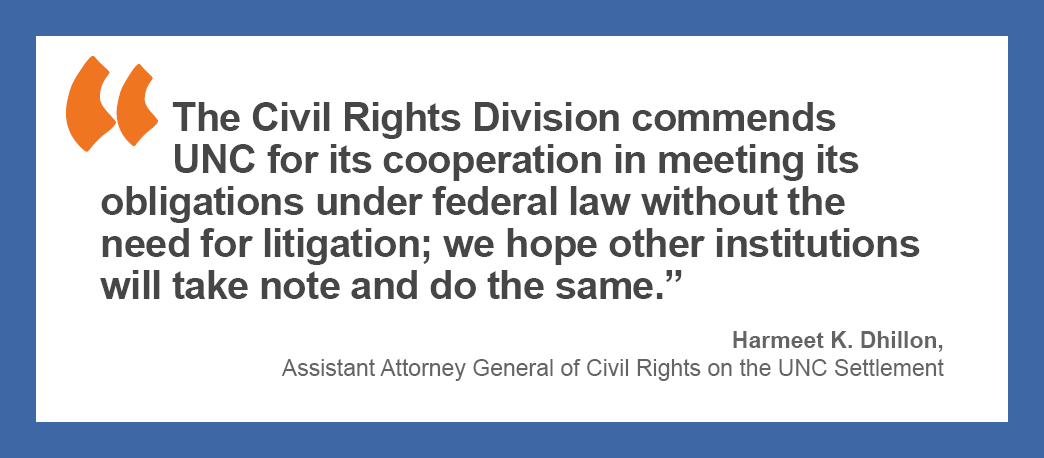
UNC officials said this deal, which resolves 18 civil rights investigations, protects the university’s mission and federal funding. They also noted the protections for academic freedom. Trump officials credited UNC for cooperating with them—comments that seemed like a subtle nod toward Harvard, which has fought the administration in court.
The UNC settlement offers another glimpse into the administration’s evolving playbook for addressing what it considers civil rights violations. While we see several provisions focused on antisemitism, two sections deal with admissions policies and ending race-based policies and programs. UNC’s agreement is the only deal of the seven reached so far that specifically requires the university to ensure that “‘affinity groups’ and graduation ceremonies … do not unlawfully segregate, exclude, limit, disadvantage, or discriminate against any candidate or participant on the basis of any Protected Characteristic.”
2. The Education Department rebuffs NACIQI. The Department of Education put one of the largest cosmetology accreditors on notice and will prohibit the group from adding new members while it awaits a compliance report.
This may seem like a solid slap on the wrist, but it comes after ED’s advisory panel recommended in a 9-to-3 vote that the department strip the accreditor’s federal recognition entirely. ED officials believe the accreditor is capable of addressing the various compliance issues, which appears to be one reason why it opted to maintain recognition for now.
This is the second time ED hasn’t followed the committee’s recommendation on recognition. The Council on Naturopathic Medical Education received a unanimous NACIQI vote recommending denial of recognition. But, as it did this week, ED gave CNME a 12-month lifeline.
Up next on the accreditation docket for ED: the accreditation arms for the American Bar Association and American Psychological Association. The advisory committee deadlocked over what to do with the legal accreditor, though half the members wanted to give the association more time to address the compliance concerns. ED staffers have already recommended stripping ABA of its status as a federally recognized accreditor.