Justin Morrison/Inside Higher Ed
RST: Sure, we are an odd couple, but I thought of another way we’re alike, Gordon.
EGG: We’re both small but mighty?
RST: Yes, that. But also, under our snarky, wisecracking exteriors, we are complete mushballs who often wax sentimental.
EGG: It is so true. It is sad that in academe expressing support or true kindness is often looked at as being either weak or even offensive. You and I have discovered in our time together that caring and kindness are something many leaders cherish. And we are just softies as we talk with each other or in conversations with so many leaders who crave being treated with respect. I am not afraid to admit that some of the stories I hear make me emotional.
RST: 💯 Higher ed is in the doghouse these days, and everyone (including us) talks about how we need to change, but let’s spend some time now focusing on what we love about this wackadoodle sector of society. It’s too much of a cliché to say students, because everyone says it and like most clichés, it’s true.
EGG: Well, let us admit it: In so many institutions and instances we give great deference to students but often do not truly put our money where our mouth is while those undergraduates are paying our bills. We need to stop as an industry and realize that students are the reason we exist. And what joy they bring to the enterprise. Some of my fondest memories are those informal moments when I met students on their turf.
RST: You were famous for not just meeting them on their turf but getting down and dirty with them. I’ve heard stories of you showing up to keggers (in your bow ties), even though we all know you drink only diet Dr Pepper.
EGG: I plead guilty. One of my favorite things was to show up unannounced at 21st birthday parties. Those were great learning experiences for me—and hopefully for them. Recently I was getting off a flight and the chief steward stopped me to ask for a selfie. Apparently, I had randomly dropped by her dorm room when she was a student at Ohio State. She told me that she was thinking of dropping out or transferring at the time, but our brief conversation compelled her to stay. Priceless! Of course, the rest of the passengers were ready to shoot me because I caused a delay in deboarding.
RST: Not, I’m sure, the first delay you’ve ever caused. I’ve noticed how often presidents get stopped by the public, because they are public figures and are often treated like celebrities.
EGG: Particularly if you are president of a large university in a small state.
RST: And are small.
EGG: And wear a bow tie.
RST: Another cliché is that the job of college or university president is like being mayor of a small town (or in your case, Gordon, a city), but the fact is that campuses are beautiful communities of true believers from the ground up. Sometimes literally. I think a lot about this guy named Gary Lavorgna who was called the “godfather of Old Campus” when I was in college. He was a groundskeeper who really saw students, especially those who were struggling, and made everyone feel welcome in a place that could be overwhelming. There are people working in dining halls, as departmental assistants, as custodians, who are the unsung heroes of student success. They work these jobs—that they could do anywhere—because they like being on campuses. They help our communities in untold and often unacknowledged ways.
EGG: Oh, Rachel, the stories I could share about the wonderful people who were like family, particularly when living in a presidential home. When I was at Ohio State, my daughter had a terrible accident, and her first husband was killed. Nancy Goodwin, the university residence housekeeper at WVU who had taken care of Rebekah when she was very young, dropped everything, took a leave from WVU and came to Columbus to help us. Hundreds of stories abound on a campus full of Good Samaritans.
RST: You were supposed to be an aristocratic banker and instead went into academia. Do you ever regret forgoing all the money, prestige and power you could have had (ha-ha-ha-ha!)?
EGG: Rachel, what a question. Here I could be in the homeland of the dinosaurs in eastern Utah lending money and foreclosing on people—or in the heart of one of the most energizing times that I can remember as a university leader for higher education. I know that sounds a bit strange coming from me, because in our column we have written frequently about the challenges and problems facing higher education. They exist, but, as I like to think, they are first-world problems. I would not have given up for one minute my time as university president to be a banker or anything else.
RST: Even when you got in trouble because you couldn’t keep your smart mouth shut?
EGG: Yes. True confession, I miss the opportunities and even the combat almost every day. The work all of us do in higher education is hard but so meaningful. And for me, as you know, I really enjoy the big public universities. What I came to realize running wonderful universities like Brown and Vanderbilt is that those institutions were so well organized that the university president was somewhat superfluous. On the other hand, when I would wake up, particularly at Ohio State or West Virginia University, and look out on the campus, I knew that if I did my work, we would make an enormous impact on the people of the state. Being a public university president is akin to being a minister: preaching the gospel of higher education to everyone and in every nook and cranny of that state.
RST: Um, not to contradict the great and wonderful wizard, but I can tell you that the leaders of fancy-pants institutions, of small private colleges, of regional publics and of community colleges, also say they are also making a difference in society and are preaching their own gospels. Every president I know is committed to their institution’s mission.
EGG: To be successful, you really need to be in love with the place. When I was being recruited to a much bigger job [from Ohio State] in 1995, I was in a hotel and was about to take the job when the concierge hauled in two big garbage bags of faxes.
RST: Faxes! You are old, Father William.
EGG: I opened up one of the bags and started reading the messages: “You milked our cow in Chillicothe, Ohio.”
RST: I would pay good money for a photo of Gordon Gee milking a cow. I’m sure you were wearing a bow tie.
EGG: Or, “You came to our small town and brought the marching band, which was the biggest gift you could have given our community.” So many of those types of messages. In a moment of sheer delight and agony, I decided to stay put. The love that people have for their universities is overpowering and the reason that, in good and bad times, our universities and colleges will always serve as centers for our culture and democracy.
RST: It’s the great irony of our times: Public confidence in higher ed as a whole is in the pooper, and yet people love their local colleges and universities. Some of that, if we’re being honest, has to do with athletics. I had to learn to love basketball when I lived in North Carolina, because it gave me a lingua franca to talk to anyone anywhere. People who never went to college still loved Duke or Carolina. Some weirdos even loved N.C. State.
EGG: Football is a religion in Ohio. In West Virginia, people in small rural areas go to the tops of the mountains to hear the broadcast of Mountaineer football and basketball. It is a unique part of our collegiate system and is one of the reasons that higher education operates at a much more personal level with citizens than the federal universities in Germany or Japan.
RST: Something I celebrate—and have been trying to teach you about 😇—is how diverse our educational ecosystem is. My father was a professor at a regional comprehensive; my mother taught at a community college and an Ivy. I resisted becoming a professor because it felt like a failure of imagination. I graduated from an Ivy, worked at a highly rejective institution, got a grad degree from a state flagship and now teach at a regional comprehensive. Here’s what I know: Getting on the tenure track at any type of institution is like winning the lottery. What other jobs have both this many degrees of freedom, this much security and the opportunity to do work you find truly meaningful?
EGG: Higher education has a calling aspect to it, which is highly unusual. Yes, first responders and many of those in public service hear and heed that call. But higher education has the advantage of being surrounded by such interesting people, whether it be students, faculty or staff. I always felt that being a university president was a daily seminar. I would, on occasion, just walk the campus bumping into students or pop by faculty offices. What a gift it is to teach and be on a university campus if you take the opportunity seriously. On the other hand, if you think of your time as a job and not a calling, you have squandered the gift that is the university.
RST: I know you love to beat up on faculty (who, let’s be clear, see it as their duty to resist The Man), but I think few if any of us see being a professor as just a job. Sure, some of us are more interested in our own work and research than in teaching, but for most, especially at small colleges and less fancy places, we are in it for the students. Because we believe in all the things we say we do. We’re changing people’s lives. And at regional publics, unlike the institutions you’ve led, Gordon, it’s a different demographic. Our students, who are not just 18 to 24 years old, have lives that are hard. Because I teach nonfiction, I know a lot about their struggles. I wrote about this a while ago. Things have not gotten better for them.
EGG: Rachel, you have made me a convert. Truly, I have been blessed to be at so-called fancy-pants universities—
RST: “So-called”? You mean, “Rachel-called.” There you go again, stealing my language, you pirate.
EGG: —but you have introduced me to some of the most energetic and creative people in higher education, whose institutions I may have heard of but did not really know. These folks lead with thoughtfulness and passion but with limited resources, so they have to be very clever. They understand they literally have no choice but to create change. My admiration knows no bounds.
RST: I also love the fact that most of our students (at non-R-1s) are people who were told they either weren’t good at school or just weren’t college material. I ask them to rise to my (high) expectations, and they rarely disappoint. Years ago, I was talking to a senior colleague about a student who we’d admitted to the graduate program in creative writing and just wasn’t cutting it. My colleague quoted back what someone from athletics once said to him: We bring them in and then we coach them up. It’s a great feeling to be invested in the success of others. When my students have won prizes, published in The New York Times and other periodicals, or have authored books, I am more thrilled than when I see my own byline appear.
EGG: Let us admit that there is much more to celebrate than we like to admit, and there are so many people doing great and meaningful work that get caught in the backwash. Thanks for coaching me up!
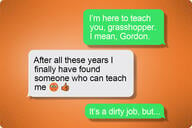
RST: I am here to teach you, grasshopper.