Justin Morrison/Inside Higher Ed
RST: Neither of us are religious, Gordon, but we both cherish some of the traditions of the faiths we were born into. I like to say I’m Jew-ish and you claim you’re culturally Mormon.
EGG: Most meaningful to me are the small tokens of a value system that is critical to who I am, like not drinking alcohol, though I do indulge in too much diet Dr. Pepper.
RST: Oh, I know all about that dirty little habit.
EGG: Actually, Rabbi David Davis, who worked with me at Vanderbilt, wrote a book about our two faiths as culturally in the same quadrant due to this unique embedded value system.
RST: Except I’m on the diet A&W Root Beer pew. I was excited to tell you the other day about the Lamed Vavniks, the idea that at any point in history, there are 36 righteous people on Earth, “hidden ones,” whose good deeds sustain the world. No one knows who they are, and they don’t even know they are one of the 36. When one dies, another takes their place. Usually they are unheralded and unknown. But I brought it up in conversation because even though she was famous, I think your friend Dolly Parton was in that group.
EGG: I do believe that there are certain people who simply exude and live by a different standard than the rest of us. When I meet them, they make me feel better and also inadequate. But in today’s divided world, we need to find a way to recognize and celebrate goodness. The Japanese designate certain of their most creative citizens as National Treasures. What a gift that would be if we had such a designation for goodness, particularly at this moment in our nation. The outpouring when it was announced that Dolly passed was not centered on her singing but on her goodness. She bound us together in some unusual way.
RST: A national treasure, and a true exemplar of character. Like Mr. Rogers. These people model what it looks like to show up as your authentic self with the humility to understand that we can all learn from others and a rare ability to talk across differences.
EGG: Oh my, Rachel. Dare we surface the words “character education” or “creating purpose” with our students?
RST: Gordon, we dare. That’s our role as columnists. And you can do it now that you are no longer a president and now can only be fired by me.
EGG: I do not mean to be snarky, but those words are too infrequently used and the concepts even more infrequently taught in our universities and colleges. And when people who exhibit notions of character surface, we are quick to look for clay feet. We all have flaws, but to not value striving for a better life as something to admire is so destructive.
RST: Well, you have flaws (see above, under Dr. Pepper). I am like Mary Poppins: practically perfect in every way. But as a faculty member, I’ve been trained to critique everything.
EGG: I am really going to raise the temperature by mentioning Charlie Kirk. I did not know him and rarely listened to him. But I admired that he would go to campuses and get in the arena. Let us not deify him or satanize him; let’s admit that he was striving to develop character. Today people so often go to their corners, huddle, drink the Kool-Aid and celebrate or condemn according to their beliefs of the moment. That is neither character nor authentic because it is group-think at its worst.
RST: Yes, and, guilty. I never listened to him because I thought I already knew what he was going to say. I stuck with my own group. When you first approached me about working together, I suspected we would be on opposite sides of an ideological divide. I worried that your association with, say, the University of Austin, would taint my progressive feminist bookish street cred. Instead, I’ve come to believe that was an ignorant and, um, bigoted position.
EGG: Oh, you are all of those things and I am a white 82-year-old one-percenter who is/was equally bigoted. But the very fact that we could find common ground while having so many differing views is the whole purpose of this exercise. We are the Odd Couple. There are zillions of odd couples out there, but the vast majority do not have the courage to listen and learn from each other. I have learned so much from you, and it has been empowering because you listened, which required me to do the same. It is amazing what can happen when ideologies are left at the door and honest engagement occurs.
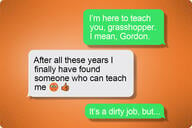
RST: 😊 So here’s a thing that I’ve gotten interested in because of our connection. You’ve been involved with civics institutes. A piece in IHE recently argued that these are not all right-wing boot camps. Which is what, embarrassingly, I used to believe. I’ve come to think that, in the age of AI, one of the most important things colleges and universities can do is to lean into teaching student about the rights and responsibility of citizenship. In fact, I introduced you to Raj Vinnakota because he’s doing such interesting work with Citizens and Scholars. And I want you to talk to Sanda Balaban at Project Pericles, whom you are going to like as much as you already admire Raj. I’m here to teach you, Grasshopper.
EGG: The focus on citizenship and civic responsibility should be at the core of a substantive education. As you’ve learned, these centers are not right-wing conspiracies but rather meant to be antidotes to the left-wing orthodoxies that exist in so many institutions. And we should not deny that there are orthodoxies in universities, which has created a fear among many students and faculty to speak their mind.
RST: Well, the fear on all sides is justified. I’ve heard horror stories from authors of the Vandy/Wash U report. Let me tell you, it’s knives out. It’s bad enough when the attacks come from the outside, but there is no room for real critique within higher ed. The bullying and nastiness are out of control.
EGG: That has always been the case. We are wonderful house critics, but when criticism is focused on the faculty or the academy, the howls of outrage can be heard from every corner. It must be so comforting to be perfect.
RST: Oh, Gordon, it is! But seriously, I think there are a zillion ways to teach civics and even character (hello, Dolly!). Those staffing these institutes don’t need to come from the usual places, like poli sci or law schools. We could draw on people with skills in drama, communications, design, literature, art, who have the ability to look closely at the world and other people to try to understand them. Maybe that’s why a civics institute should really be about: teaching students how to truly be human and to live in a civil society with others.
EGG: Rachel, that is brilliant. And is that not exactly what higher education should be doing? If we were pursuing this in abundance, we would not need civic institutes, nor would we need a lot of other programs within the university.
RST: What I keep coming back to is this: How do we inculcate a sense of curiosity? How do we teach and learn to listen closely, ask good (not hostile) questions, and really see other people? That is the realm of novelists, artists—well, of the humanities. I see so many students who are trained to focus only on getting the “right” answer; they don’t know what it feels like to be truly interested and curious in school.
EGG: Maybe this is the most important question we should be asking of ourselves and all who have responsibilities for educating the next generation. I believe ever more strongly that universities need to be places of healing and not of division. And that will only happen when we inside the academy accept that all ideas are welcome, fear of speaking up is eradicated, and that individual worth is recognized. If universities cannot dream and heal, I fear that it will not occur anywhere in our social structure.
RST: Amen/shalom/namaste, friend.