
keeperofthezoo/iStock/Getty Images Plus
Over the past two decades, I’ve spent countless hours traveling to education conferences, sitting in university boardrooms and participating in policy panels across the country. In every room, the same word gets thrown around as a cure-all for higher education’s challenges: accountability. But almost no one agrees on what it actually means. Ever since No Child Left Behind, the term has dominated education policy, with the definition depending entirely on whom you ask.
A higher education economist hears the word “accountability” and thinks about postgrad wages, starting salaries and cost per degree. An assessment director hears the same word and pictures student learning outcomes, rubric scores and intellectual growth. An accreditor hears it and expects regulatory compliance, regional standards and peer review.
Unfortunately, this isn’t just a harmless semantic debate. Meaning matters in policy and governance, and when an ambiguous concept becomes the cornerstone of public policy, institutions end up trying to satisfy every interpretation simultaneously at enormous cost.
The end result is a complex landscape marked by what I’ve termed the seven silos of accountability. In an era of shrinking budgets and growing regulatory demands, cutting through this challenging landscape could be the difference between institutional stability and another round of difficult cuts—or worse.
3 Forces Pulling Your Institution Apart
To understand why accountability remains an ambiguous concept, we must recognize the three distinct social spheres pulling postsecondary institutions in different directions.
- The State: Governors, lawmakers and state boards want regulatory compliance, alignment with local workforce needs and performance-funding results. They view your university as a public utility that should produce trained workers efficiently while keeping costs down.
- The Profession: Faculty, accreditors and scholarly peers care about academic rigor, research, shared governance and student learning. They tend to see education as an intellectual journey that strengthens democracy, not an individual commercial transaction.
- The Market: Students, parents and employers want a financial return on investment. They look at job placement, starting pay, tuition costs and postgraduation debt. If your graduates do not land well-paying jobs quickly, market advocates claim your institution is failing.
Each group measures what it values most, and when these three spheres collide, leaders get stuck in the middle. If you focus only on salary data, faculty accuse you of running a trade school. If you focus only on academic theory, lawmakers threaten your budget. You end up trying to balance economic ROI, legal mandates and educational depth all at once without a clear framework to resolve the tensions.
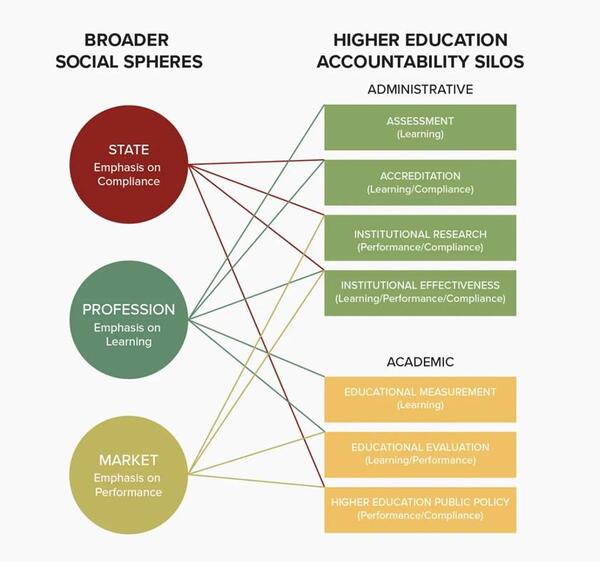
Social Spheres and Accountability Silos
The 7 Silos
Over time, this balancing act has produced an all-too-familiar enemy of efficiency: an ecosystem of specialization silos within the academy to handle competing demands.
- Assessment: Measures course-level student learning outcomes and teaching effectiveness.
- Accreditation: Manages regional and program-specific standards of quality.
- Institutional research: Handles mandatory state and federal reporting alongside campus enrollment statistics.
- Institutional effectiveness: Tracks administrative unit plans and operational metrics to link budgeting, planning and assessment across the university.
- Educational measurement: Focuses on psychometric theory and standardized test design.
- Educational evaluation: Measures the impact of specific grant-funded programs or initiatives.
- Public policy: Tracks legislative mandates and state governance requirements.
Each of these seven fields has formed its own national association, scholarly journals and internal vocabulary. As a result, each operates as a distinct domain rather than part of a shared whole. For institutions already balancing tight budgets, the costs can be severe.
University staff capture the same data multiple times and report it to different agencies in different formats, wasting time and resources—like we are seeing with colleges scrambling to meet the new Admissions and Consumer Transparency Supplement requirement of years of disaggregated data spanning admissions, financial aid, GPAs and student demographics.
A report submitted to state legislators might use definitions of student success that contradict the data compiled for an accreditor, threatening the institution’s credibility. Faculty stop seeing accountability as a tool for improvement and start viewing it as a box-checking burden—look no further than the current state of learning outcomes, as Hollis Robbins covers on her Substack.
From Fragmentation to Integration
It doesn’t have to be this way. Universities can fight functional fragmentation and the ambiguity of accountability. Higher education is not the only sector that struggles with cross-departmental efficiency; institutions can borrow from industries that have become adept at integration.
Here are some solutions that focus on process:
- Set up a cross-functional data team, bringing your leads from institutional research, assessment, institutional effectiveness, business intelligence, accreditation and public policy into one council. Make sure they agree on definitions before anyone collects a single metric.
- Build balanced ROI metrics, combining career outcomes, learning gains and social mobility into one score. Don’t let external critics force a choice between salary statistics and educational depth.
- Teach your team to translate across divisions. Train your institutional research analysts to understand assessment rubrics. Teach your assessment coordinators how state funding formulas work.
- Use modern data tools. Deploy enterprise platforms to pull data automatically across departments, cutting down on duplicate reporting and saving hours for your staff.
And here are some solutions that focus on structure:
- Unify leadership by putting institutional research, institutional effectiveness, assessment and accreditation under one executive leader—such as a vice provost for institutional strategy. Add “accountability liaisons” within academic units who report locally but maintain a dotted-line relationship to that leader.
- Centralize your data infrastructure by building a single data warehouse that houses learning rubrics, postgraduation employment outcomes and state compliance figures to serve as the institution’s single source of truth.
- Establish a standing steering committee of directors from different silos to govern institutional data assets and resolve conflicting definitions.
- Engineer “double-dipping” opportunities by training your teams to flag reporting overlaps and use the same data for multiple agencies. One good report on first-generation student outcomes can serve federal grants, state funding metrics and regional accreditation reviews. Have executives take those examples of redundancies to external state agencies and accreditors to lobby for simpler, combined reporting rules.
The Choice
Accountability in higher education isn’t going away, and it shouldn’t. But to make it work, we must understand the tangled web we have woven. Across the country, universities are caught in the same snare. The ambiguity of accountability lets seven isolated silos dictate conflicting data strategies that systematically drain budgets, exhaust faculty and leave campus leaders vulnerable to competing demands from the market, the state and the profession.
The problem spans the entire postsecondary ecosystem, but the path to a solution begins locally. By taking control of the accountability narrative through structural and process changes, leaders can transform compliance from a reactive, box-checking exercise into a driver of institutional strategy.
As the common business saying goes, “What gets measured gets managed.” But a deeper truth is this: “What gets unified gets understood.” Higher education can no longer afford to treat accountability as a fragmented, school-by-school burden. The path forward requires breaking down these walls, aligning metrics and leading with a unified vision of success.


